

Grief on Repeat: Coping Strategies for Tough Anniversaries
When the Calendar Becomes a Source of Pain: Anniversary Grief Coping Strategies That Actually Help
Anniversary grief coping strategies can make the difference between being blindsided by a difficult date and moving through it with intention and self-compassion. If you’re approaching a death anniversary, a birthday, or another significant milestone and already feeling the weight of it, you’re not alone, and you’re not falling apart.
Here are the core strategies at a glance:
- Map your grief calendar: identify the dates and the weeks leading up to them
- Design meaningful rituals: honor your loved one in a way that feels right to you
- Use somatic grounding techniques: calm your nervous system when emotions surge
- Set clear boundaries: communicate your needs to family and friends before the day arrives
- Build a long-term recovery plan: including rest time after the anniversary passes
These five steps are the backbone of this guide.
Grief doesn’t follow a straight line. It moves in waves, sometimes small, sometimes enormous. And on certain dates, those waves can feel like a tsunami, even years after a loss.
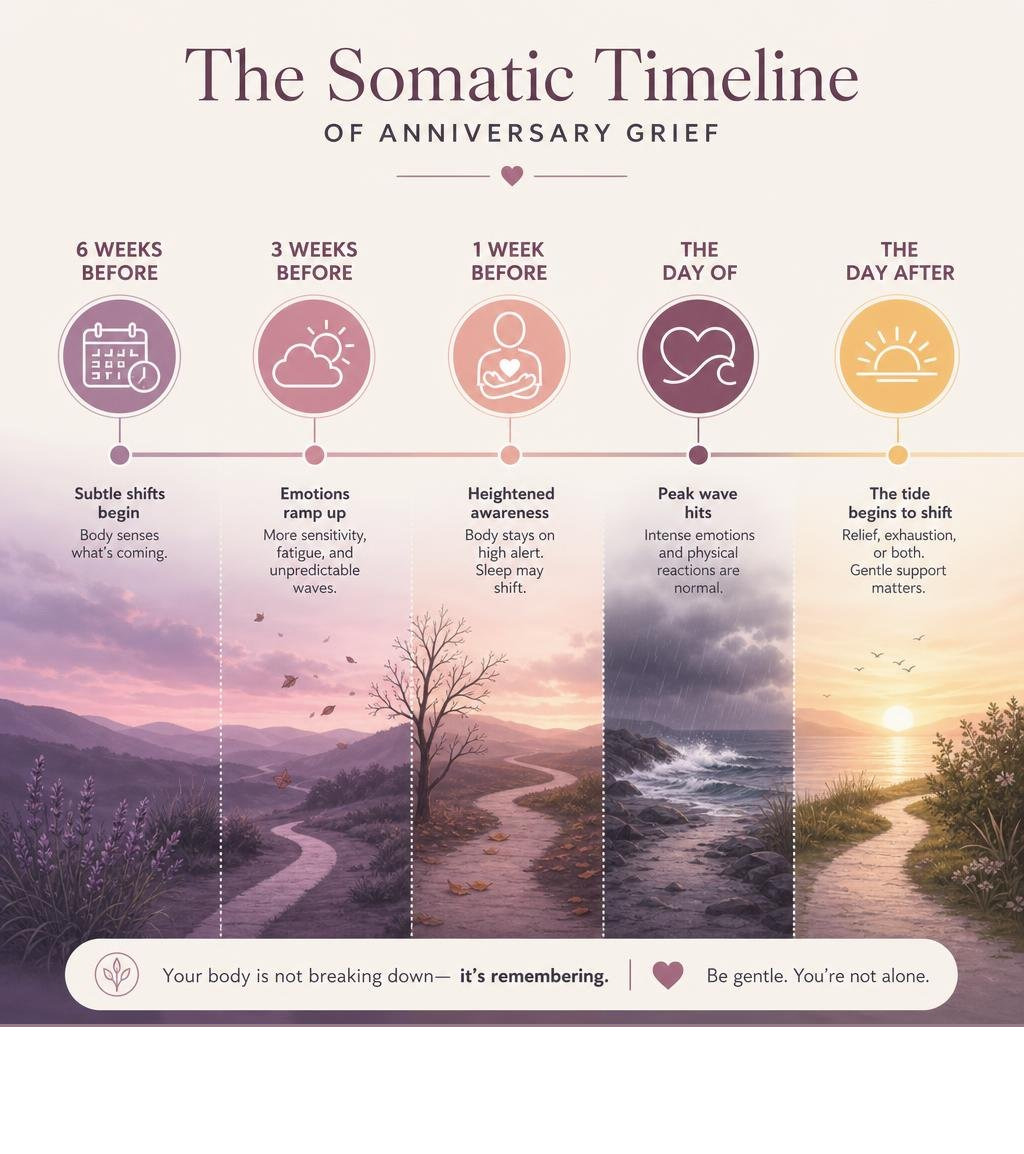
There’s a reason for that. Your body holds the memory of loss, often before your conscious mind even registers what’s coming. You might notice unexplained fatigue, poor sleep, or a low mood weeks before you think to check the calendar. That’s not weakness. That’s your nervous system doing exactly what it was built to do.
As grief researchers put it: the brain encodes emotionally intense experiences with heightened vividness. Significant dates become anchors for that encoded pain, and they don’t fade simply because time has passed.
Whether this is your first death anniversary or your tenth, this guide walks you through five clear, practical steps to navigate it.
At Stegall Counseling, PLLC, we have extensive experience helping partners develop anniversary grief coping strategies that meet them where they actually are, not where they think they should be. In the sections ahead, we’ll break down exactly what’s happening in your mind and body on these difficult dates, and how to move through them with more agency and less dread.
Why Significant Dates Trigger Intense Somatic Reactions
When we experience a significant loss, our brains don’t just store the event as a neat, chronological memory. Instead, the amygdala, the brain’s emotional alarm system, encodes the experience with intense physiological vividness. When a certain time of year rolls around, our biology reacts to seasonal cues, light angles, and temperature drops before we even consciously register the date.
This deep somatic connection is why we often feel physically ill, anxious, or deeply fatigued in the weeks leading up to a milestone. The nervous system remembers the trauma of the loss and triggers a survival response. To understand how these seasonal transitions interact with our internal timeline, it helps to explore Seasonal Anniversary Grief Responses | GriefLantern, which highlights how our bodies naturally sync with the environment to trigger memory pathways.
Furthermore, these triggers can be uniquely painful depending on the nature of the relationship. For instance, spouses share daily routines and future plans, making the disruption of those shared rhythms incredibly loud when significant dates arrive. You can read more about this specialized dynamic in Why Anniversaries Hit Harder After Losing Your Spouse: Understanding Grief Triggers and 10 Ways to Cope With Emotional Pain on Significant Dates.
How the Body Remembers Loss Before the Mind
Have you ever woken up feeling an inexplicable sense of dread, heavy-limbed and tearful, only to realize a few minutes later that “Oh, next week is the date”? That is your implicit memory at work. While explicit memory allows us to recall facts and dates, implicit memory is somatic. It lives in our muscles, our heart rate, and our nervous system.
During these times, your “body clock” reacts to subtle sensory triggers: the smell of autumn air, the specific way the spring sun hits the kitchen floor, or the sudden shortening of daylight. This somatic anticipation often triggers intense anticipatory anxiety. When this happens, you might ask yourself: Why am I falling apart? Am I backsliding?
We want to reassure you that these physical and emotional responses are completely normal. If you are struggling with these sudden, intense waves of feeling, it can be incredibly grounding to read our resource on Are My Emotions Valid? Understanding Emotional Regulation and Overwhelming Feelings. Your body is not broken; it is simply expressing the depth of your love and the reality of your loss.
The Evolution of Grief Over Years and Decades
Grief does not follow a neat, linear trajectory where you cry less every single day until you are “cured.” Instead, we use the “wave model” of grief. In the first year, you are often protected by a layer of shock and numbness. Every holiday, birthday, and changing season is a difficult “first.”
By the second year, however, that protective shock has worn off, and the permanent reality of the loss solidifies. Many of our therapists at Stegall Counseling, PLLC find that the second anniversary actually feels harder than the first because the initial wave of community support has faded, leaving them to face the quiet permanence of the absence alone.
As the years pass, anniversary grief often changes shape rather than disappearing. The difficult days may become less frequent, but certain milestones, like five, ten, or twenty years after the loss, can still bring powerful emotions back to the surface. If a significant date is coming up and you feel overwhelmed, you do not have to move through it alone. Contact Stegall Counseling, PLLC to talk with a therapist about support for grief and loss.
The 5-Step Protocol for Anniversary Grief Coping Strategies
Rather than letting the anniversary simply “happen” to you, engaging in proactive planning can restore a sense of agency and reduce the paralyzing dread that often builds up beforehand.

This protocol is designed to help you prepare emotionally, physically, and socially. For a broader look at how structured preparation can ease the burden of these dates, you can read Anniversary Grief: Coping with Difficult Dates After Loss.
Step 1: Map Your Personal Grief Calendar and Anticipate Triggers
The first step in taking back control is to map out your personal grief calendar. This goes beyond the obvious date of passing. It includes:
- Birthdays (both yours and your loved one’s)
- Wedding anniversaries or dating milestones
- The date of a diagnosis or sudden hospitalization
- Seasonal shifts that carry strong sensory associations
We recommend opening your calendar about six weeks before a known difficult date. By identifying these periods early, you can avoid scheduling high-stress work deadlines, major surgeries, or overwhelming social obligations during those weeks. Giving yourself this “emotional weather warning” allows you to practice proactive self-care. For practical ways to manage your daily capacity when triggers arise, check out our Emotional Regulation Tips.
Step 2: Design Meaningful Rituals to Honor Your Loved One
Rituals give our grief a physical place to go. Without a structured outlet, the pain can feel amorphous and overwhelming. When designing a ritual, choose something that matches your actual emotional capacity rather than what you feel obligated to do.
Here are a few meaningful ideas:
- The Memory Box: Spend time looking through keepsakes, letters, or photos. You can write down a favorite memory from the past year on a slip of paper and add it to the box.
- Favorite Meals: Cook their signature recipe or host a small pot-luck with friends where everyone brings a dish your loved one enjoyed.
- Letter Writing: Write a letter directly to them, sharing what has happened in your life over the past year. Some find comfort in safely burning, burying, or keeping these letters in a private journal.
- Living Memorials: Plant a tree, a flower, or place a memorial stone in a garden space they would have loved.
Whatever you choose, the goal is connection, not performance. If you are looking for a deeper way to process these heavy emotions and find release, read our guide on Unburdening Your Soul.
Step 3: Implement Somatic Anniversary Grief Coping Strategies
Because anniversary grief is stored deeply in the body, intellectualizing your pain is rarely enough. We must actively work to calm the nervous system when somatic triggers cause a fight-or-flight response.
One of the most effective, immediate tools is the 4-4-6 breathing technique:
- Inhale deeply through your nose for a count of 4.
- Hold your breath gently for a count of 4.
- Exhale slowly through your mouth for a count of 6.
This extended exhale directly stimulates your vagus nerve, signaling to your brain that you are safe and activating your parasympathetic nervous system. If you find yourself in a state of acute emotional overwhelm, you can also use somatic grounding techniques, such as holding an ice cube, running cold water over your wrists, or placing your bare feet flat on the floor and naming five things you can see around you.
To expand your toolkit for these intense moments, explore our guide on Feeling Overwhelmed? Take Control with the TIPP Skills and learn how to anchor yourself by reading Breathe Deeply: What Does It Mean to Live in the Moment?.
Step 4: Set Boundaries with Friends and Family
Not everyone in your social circle will understand why you are still struggling, especially as the years pass. Well-meaning friends might try to “distract” you or pressure you to attend social events when you simply want to rest.
Preparing a few clear boundary scripts in advance can save you immense energy:
- “The anniversary of my partner’s passing is next week. It’s always a really heavy time for me, so I’m going to lay low and take some quiet time for myself.”
- “I appreciate you inviting me out, but I need to spend this day honoring my loved one in a quiet way. Let’s catch up next week instead.”
It is also important to recognize that different family members grieve differently. One sibling may want to look at photos and cry, while another may need to stay busy and distracted. Both paths are completely valid. Understanding how to communicate these differences can transform your support system; read more on how to navigate this in How Validation Can Transform Your Relationships.
Step 5: Establish Long-Term Anniversary Grief Coping Strategies
Navigating difficult dates is a marathon, not a sprint. A robust, long-term plan must account for the “post-anniversary letdown.” Often, we expend so much emotional energy anticipating and getting through the actual day that we are completely blindsided by a wave of exhaustion, headaches, or depressive symptoms the day after.
When building your plan, always schedule a “recovery day” immediately following the anniversary. Keep your schedule clear of heavy demands, stock your kitchen with easy-to-prepare comfort foods, and give yourself permission to simply rest.
If you are navigating these dates as a family, it is also vital to support any children involved. Children experience grief in short, intense bursts and may express their pain through behavioral changes rather than words. For gentle, age-appropriate strategies to help the younger members of your family navigate these milestones, see A Practical Guide to Child Grief Counseling.
Normal Milestones vs. Complicated Grief: When to Seek Professional Help
It is entirely normal to feel sad, distracted, and physically tired around a milestone. However, there is a difference between the natural, temporary waves of anniversary grief and complicated grief (clinically known as Prolonged Grief Disorder).
Prolonged Grief Disorder affects approximately 7% to 10% of bereaved individuals. It is characterized by severe, daily grief symptoms that persist for 12 months or longer after the loss and cause significant functional impairment in your daily life, such as an inability to return to work, complete self-care tasks, or maintain relationships.
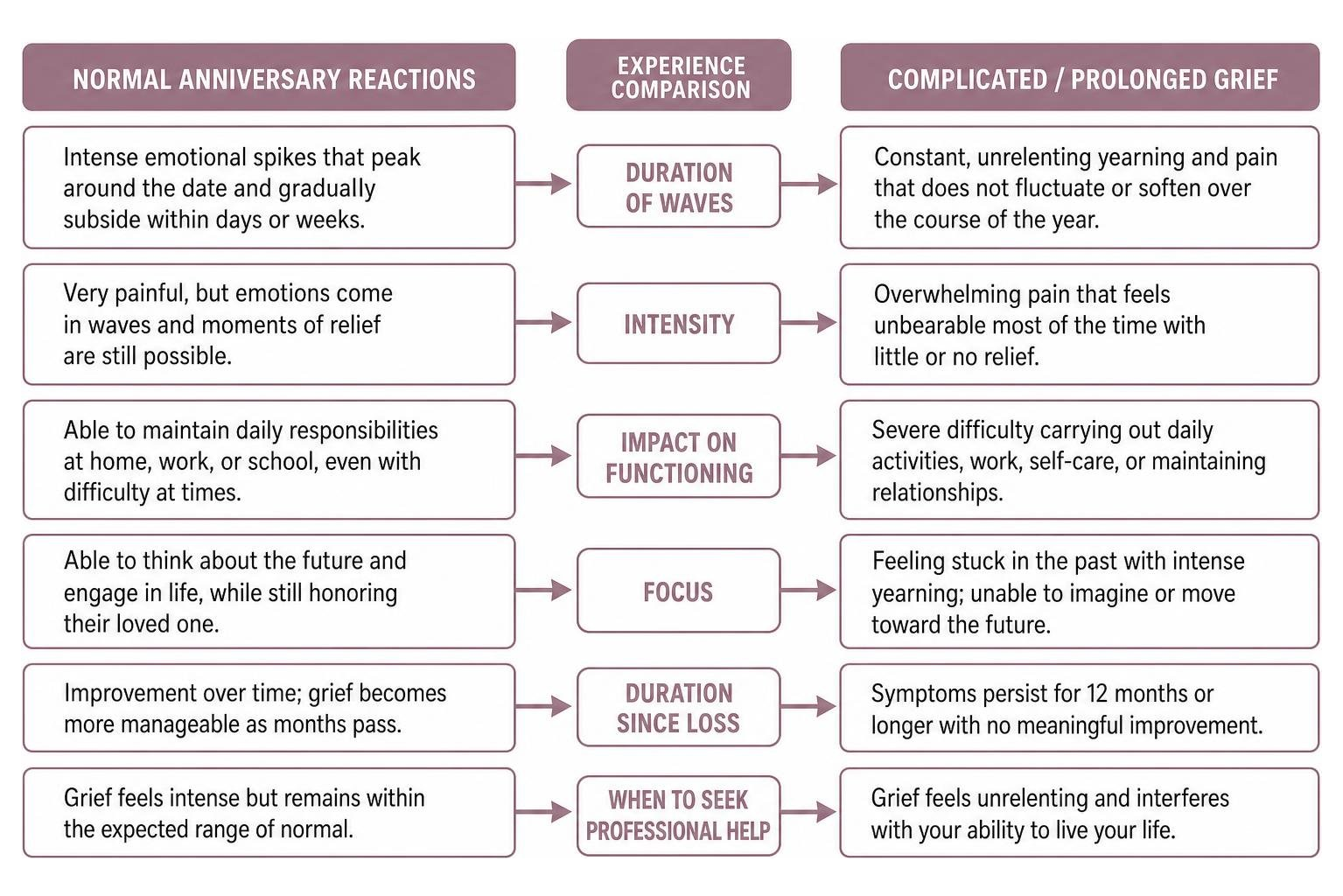
To help you understand where your experience might fall, we have outlined the key differences below:
| Symptom / Experience | Normal Anniversary Grief Reaction | Complicated / Prolonged Grief |
|---|---|---|
| Duration of Waves | Intense emotional spikes that peak around the date and gradually subside within a few days or weeks. | Constant, unrelenting yearning and pain that does not fluctuate or soften over the course of the year. |
| Daily Functioning | You are generally able to work, care for yourself, and experience moments of joy, even if the anniversary temporarily disrupts this. | Severe disruption in daily life; unable to maintain employment, personal hygiene, or basic household tasks. |
| Sense of Identity | Though deeply changed by the loss, you are slowly integrating the absence into your ongoing life story. | A persistent feeling that life has completely ended, accompanied by a total loss of purpose or identity. |
| Social Connection | You may seek solitude around the date but remain capable of connecting with safe, supportive loved ones. | Complete, long-term isolation; avoiding all social contact and refusing any form of support. |
If you recognize the signs of complicated grief in yourself or a loved one, please know that seeking help is a profound act of strength. At Stegall Counseling, PLLC, we walk alongside our partners to help them process their pain without judgment. You can read more about our personalized approach on our Grief and Loss Counseling page.
Frequently Asked Questions About Grief Anniversaries

Why do I feel worse in the weeks leading up to a death anniversary?
This is a highly common experience known as anticipatory anxiety or somatic anticipation. Your nervous system stores the sensory details of the trauma, such as the angle of the sun, the temperature, or seasonal smells, and begins to react to these environmental cues before your conscious mind even realizes the date is approaching.
This somatic response can trigger feelings of irritability, sleep disruptions, and deep fatigue up to six weeks before the actual anniversary.
Is it normal for the second anniversary to feel harder than the first?
Yes, this is incredibly common. During the first year, many people are still operating in a state of survival, shock, and emotional numbness.
By the second year, that initial numbness wears off, and the permanent reality of the loss truly sinks in. Additionally, the external support from friends, family, and colleagues often declines during the second year, leaving the grieving individual feeling more isolated as they navigate the milestone.
What if I prefer to do nothing special on the anniversary date?
Choosing not to mark the anniversary with specific rituals is a completely valid and healthy coping mechanism. For some, the pressure of planning an elaborate memorial causes unnecessary anxiety.
Treating the anniversary as an ordinary day, focusing on distraction, or simply letting the day pass quietly is a legitimate choice that honors your personal needs. There is no “right” way to grieve.
Conclusion
Anniversaries are not setbacks in your healing journey; they are a testament to the enduring love you carry for the person who died. Integrating loss into your life is a deeply personal, non-linear process that requires immense self-compassion, patience, and a willingness to listen to what your mind and body need.
At Stegall Counseling, PLLC, located in Indian Trail, NC, we offer a warm, relatable, and compassionate space to help you navigate these difficult milestones. We believe that healing is not about forgetting or moving on quickly, but rather learning to live with your loss in a way that honors both yourself and your loved one.
If a painful anniversary is approaching, you do not have to wait until you are in crisis to ask for support. Connect with Stegall Counseling, PLLC to schedule a consultation and find grief support that meets you where you are. We are here to support you through every wave.