

Why So Many Couples Struggle to Connect — And What Actually Helps
Couples communication training gives partners a structured way to break frustrating patterns, feel genuinely heard, and rebuild connection without years of guesswork.
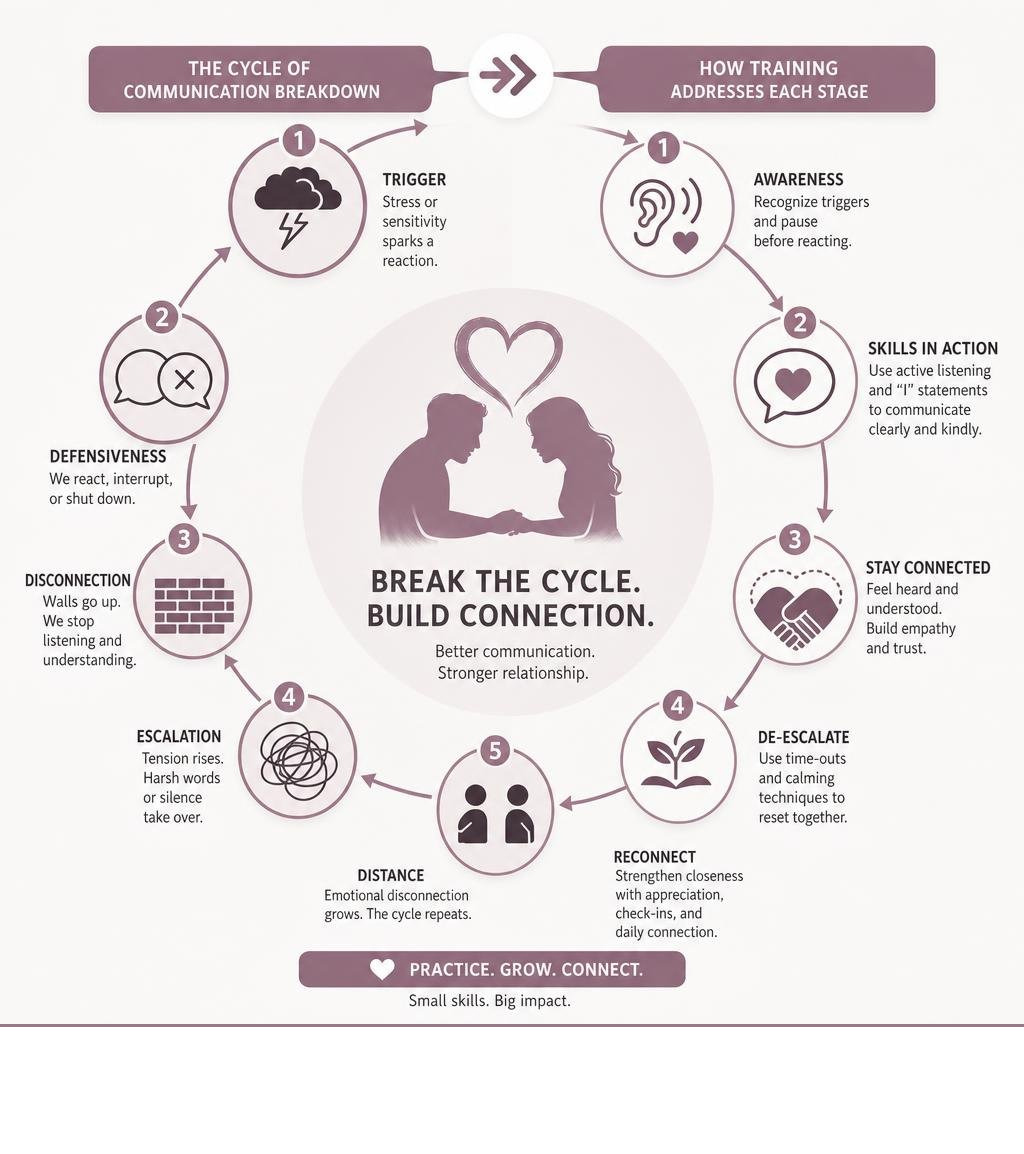
Here’s what it typically involves:
- Learning active listening — giving full attention and reflecting back what your partner says
- Using ‘I’ statements — expressing feelings without blame or criticism
- Recognizing emotional triggers — understanding what causes defensive reactions
- Practicing structured techniques — like the Speaker-Listener method and soft start-ups
- De-escalating conflict — using time-out strategies when emotions run high
- Building daily connection habits — regular check-ins, appreciation, and stress-reducing conversations
Communication is the heartbeat of any relationship, yet it’s often the first thing to break down under stress. Research suggests that roughly 65% of divorces are linked to poor communication, and many couples spend years repeating the same arguments without knowing why. The problem usually isn’t a lack of love. It’s a lack of specific, learnable skills that most people were simply never taught.
The good news? These skills can be learned. Whether you’re navigating constant conflict, growing emotional distance, or just feeling like you’re talking at each other instead of with each other, structured training can make a measurable difference. Studies show couples who practice communication exercises report a 30% increase in relationship satisfaction and a 25% reduction in conflict frequency.
At Stegall Counseling PLLC, we’ve seen how couples communication skills helps partners move from disconnection to genuine understanding. This guide walks you through the core techniques, common roadblocks, and practical exercises you can start using today.
Why Couples Communication Is Essential
Most of us graduated high school knowing how to solve for x and identify the powerhouse of the cell, but we never received a single class on how to tell the person we love that their chewing sounds like a woodchipper without starting a three-day cold war. We are expected to intuitively know how to communicate vulnerably, but the reality is that healthy communication is a set of skills, not an instinct.
When communication breaks down, it doesn’t just make dinner conversations quiet; it actively erodes the foundation of trust and safety in your relationship. Partners begin to harbor unspoken resentments, make negative assumptions, and withdraw into protective shells. This is where relationship anxiety thrives, turning minor misunderstandings into existential threats to your bond. If you find yourself constantly waiting for the other shoe to drop, you might find our Ultimate Checklist for Managing Relationship Anxiety helpful for identifying those underlying fears.
The research-backed benefits of engaging in structured communication training are undeniable. Studies show that couples who participate in communication skills training experience a:
- 40% improvement in emotional intimacy
- 35% decrease in defensive responses during conflicts
- 50% reduction in misunderstandings when actively utilizing “I” statements and active listening
According to the Gottman Institute’s guide on relationship communication, 94% of the time, the way a discussion begins determines how it will end. If you start a conversation with a harsh critique, it is almost guaranteed to end in a fight. Communication training teaches couples how to bypass these predictable traps, replacing the impulse to win an argument with the desire to understand each other.
Learning these tools is about creating a secure emotional base. When you know you can bring up a difficult topic without triggering a relationship-ending blowout, you stop walking on eggshells. You begin to experience the relationship as a safe harbor rather than a minefield.
Core Techniques in Couples Communication

To move past surface-level arguments and build deep emotional intimacy, couples must learn to swap their default defensive habits for structured communication techniques. In our counseling practice, we focus on a few core tools that consistently yield the highest return on emotional investment.
1. The Speaker-Listener Technique
This is the gold standard of communication exercises. It is designed to slow down conversations when a topic is highly sensitive or emotionally charged. The primary rule is that only one person can hold the floor at a time. You can even use a physical object, like a television remote or a “talking stick,” to represent who is the Speaker.
- Rules for the Speaker:
- Speak for yourself using “I” statements.
- Keep your statements brief (aim for 10 words or less per turn) so your partner doesn’t get overwhelmed.
- Do not try to solve the problem yet; simply express your perspective or feelings.
- Rules for the Listener:
- Focus entirely on what the Speaker is saying without formulating your rebuttal.
- Paraphrase what you heard before responding or switching roles. For example: “It sounds like you felt really overwhelmed when I came home late and didn’t text. Is that right?”
- Do not offer advice, solutions, or counter-arguments while listening.
The goal here is not agreement; it is mutual comprehension. As we outline in our guide on How Validation Can Transform Your Relationships, validating your partner’s experience does not mean you agree with their perspective. It simply means you acknowledge that their feelings are real and make sense given their experience.
2. Assertive Communication and “I” Statements
Many couples fall into the trap of aggressive communication, which focuses on blaming the other person. This sounds like: “You always ignore me when you get home!”
Assertive communication, on the other hand, allows you to express your needs clearly and constructively without triggering your partner’s defenses. To do this, we use a simple three-step formula:
“I feel [emotion] when [describe the specific behavior without judgment] and I would prefer it if [make a specific, positive request].”
- Instead of: “You never help around the house. You’re so lazy!”
- Try: “I feel overwhelmed when the kitchen is messy after dinner, and I would prefer it if we could split the cleanup duties tonight.”
By shifting the focus from your partner’s character flaws to your own feelings and specific requests, you invite cooperation instead of a defensive counter-attack.
Defensive Reactions vs. Active Listening
To help visualize how these patterns play out in real life, consider the difference between a typical defensive reaction and an active listening response:
| Scenario / Trigger | Defensive Reaction (Escalates Conflict) | Active Listening Response (De-escalates Conflict) |
|---|---|---|
| “I feel like we haven’t spent any quality time together lately.” | “Oh, so now it’s my fault? I’ve been working 60 hours a week to pay our bills!” | “I hear you, and I miss you too. It has been a crazy couple of weeks. Let’s look at our calendars tonight.” |
| “It really bothered me when you forgot to call when you were running late.” | “You always find something to complain about. I was busy!” | “I’m sorry I forgot to call. I can see how that made you feel worried and unimportant.” |
| “I’m feeling really stressed about our budget this month.” | “Well, maybe if you didn’t spend so much on takeout, we’d be fine!” | “I know, it’s a tight month. It stresses me out too. Let’s sit down and figure it out together.” |
Overcoming Common Roadblocks and De-escalating Conflict
Even the most practiced couples will occasionally experience “emotional flooding”. This is the state where your nervous system goes into fight-or-flight mode, making rational communication physically impossible. When you are flooded, your heart rate climbs, your breathing becomes shallow, and you can no longer process logical arguments.
If you try to resolve a conflict while flooded, you will inevitably run into the “Four Horsemen” of relationship distress: criticism, defensiveness, contempt, and stonewalling. Understanding these patterns is essential for keeping arguments from spinning out of control. For example, if you or your partner tend to completely shut down and pull away during a fight, you can read more about this specific dynamic in our breakdown of What is Stonewalling?.
To manage emotional flooding and de-escalate conflict, we recommend integrating the following strategies:
- The Time-Out Strategy: When you notice physical signs of anger (clenched jaw, racing heart, or the urge to scream), it is time to call a timeout. Agree on a neutral signal beforehand.
- The Rules of a Timeout:
- Anyone can call a timeout at any time.
- The person calling it must suggest a specific time to return and finish the conversation (e.g., “I’m feeling too flooded to think straight. I need to take a 20-minute break, but let’s talk about this at 7:00 PM.”).
- During the break, do not stew on the argument. Engage in self-soothing activities like deep breathing, going for a walk, or listening to music.
- You must return to the conversation as promised.
- Separating Problem Discussion from Problem Solution: Do not try to solve a problem while you are still trying to understand it. Keep these as two entirely separate phases of your conversation. Spend 80% of your time ensuring both partners feel heard, and only 20% brainstorming solutions.
- Focusing on “We-ness”: Approach external stressors (work, parenting, finances) as a team. Frame the challenge not as You vs. Me, but as Us vs. The Problem. Research on couples emphasizes this team-first approach, showing that couples who manage external stress together report significantly higher relationship stability.
Practical Exercises to Strengthen Your Connection

Just like physical fitness, maintaining a strong relationship requires regular, intentional practice. You don’t wait until you’re running a marathon to start jogging; similarly, you shouldn’t wait for a crisis to practice your communication skills.
Here are three practical exercises you can build into your weekly routine to keep your emotional connection strong:
1. The Weekly 30-Minute Couples Meeting
Set aside 30 minutes every single week at a designated, distraction-free time (no phones, no kids, no work laptops). Divide the meeting into four structured segments:
- Appreciation (10 minutes): Share at least three specific things you appreciated about your partner over the past week. (e.g., “I loved when you made coffee for me on Tuesday morning when I was running late.”)
- Planning for Good Times (5 minutes): Schedule a date night, a walk, or some dedicated screen-free time together.
- Addressing Problems/Challenges (10 minutes): Bring up one or two minor issues using soft start-ups and “I” statements.
- Values and Goals (5 minutes): Briefly discuss a shared dream, a home project, or a financial goal to remind yourselves of your shared vision.
2. Daily Stress-Reducing Conversations
Spend 15 to 20 minutes every evening talking about each other’s day, with one major catch: you cannot talk about your relationship, and you cannot try to solve each other’s problems.
The goal of this conversation is simply to provide a safe space to decompress from external stressors (like a difficult boss, traffic, or family drama). Practice taking your partner’s side, validating their frustrations, and expressing empathy. If you want to learn more about how to connect deeply during these quiet moments, you might enjoy exploring our article on Love Languages: Speaking the Dialect of Your Loved One’s Heart.
3. The “Turning Toward” Challenge
In our daily lives, we constantly make “bids for connection.” A bid can be a sigh, a question, a touch, or pointing out something on the news. Gottman research shows that couples who stay together “turn toward” these bids 86% of the time, while those who divorce only do so 33% of the time.
Make it a game to notice and positively respond to your partner’s bids. If they say, “Wow, look at that bird outside,” don’t just grunt. Put down your phone, look out the window, and engage. These tiny, daily moments of connection build up a massive reserve in your “Emotional Bank Account,” which you can draw from when times get tough. For structured guidance on implementing these routines, establishing consistent habits is key.
Frequently Asked Questions About Couples Communication
To help you better navigate this journey, we’ve compiled answers to some of the most common questions couples ask when looking to improve their dialogue.
What are the most common barriers addressed in couples communication?
The most common barriers include a lack of active listening (listening only to prepare a counter-argument), making negative assumptions about your partner’s intentions, and falling into defensive patterns.
Many couples also struggle with different communication styles shaped by their upbringings or past experiences. Training helps partners identify these unconscious patterns and replace them with conscious, constructive tools.
How does couples communication skills help de-escalate heated arguments?
It teaches partners to recognize the physical and emotional signs of “flooding” (being overwhelmed by anger or stress) and provides a structured “timeout” protocol to de-escalate the situation.
By teaching you how to use soft start-ups and self-soothing techniques, training ensures that arguments are paused before they turn into destructive shouting matches or icy silences.
Can we practice couples communication exercises at home?
Absolutely! In fact, practicing at home is where the real work happens. You can start by setting up a weekly 30-minute meeting, practicing the Speaker-Listener Technique with neutral topics (like planning a vacation), and making an effort to use “I” statements in daily conversations.
If you’re looking for more guidance on building these habits outside of a therapy office, check out our guide on Nurturing Connections: Building and Maintaining Healthy Adult Relationships or explore our insights on Navigating Relationships and Single Life.
Conclusion
At the end of the day, improving your communication isn’t about learning how to never disagree. It is about learning how to navigate those disagreements in a way that actually brings you closer together. Conflict is an inevitable part of sharing a life with another human being, but it doesn’t have to be destructive. With the right tools, every disagreement can become an opportunity to understand your partner a little bit better.
At Stegall Counseling PLLC, we specialize in helping couples cut through the noise, quiet the defensive reactions, and rebuild their emotional connection. We offer a warm, relatable, and humor-infused approach to therapy, ensuring that you and your partner feel supported, understood, and comfortable throughout the process. We also offer convenient options to make getting help as seamless as possible.
If you are ready to stop repeating the same old fights and start building a stronger, more resilient partnership, we are here to help. To learn more about our approach, check out our services on Relationship Counseling & Life Transitions.
Ready to take the next step? Visit our homepage, explore our specialties, or contact us today to schedule your initial consultation. Let’s work together to build the connected, peaceful relationship you both deserve.