

When Love Feels Like Worry: Understanding Anxiety in Romantic Relationships
Anxiety in romantic relationships is extremely common, and it can quietly drain the joy out of even a healthy partnership.
Here’s a quick overview of what it is and what you can do:
- What it is: Persistent worry, doubt, or fear about your relationship or partner, even when things are going well
- Common signs: Overthinking, seeking constant reassurance, self-silencing, or pushing your partner away
- Main causes: Anxious attachment style, past relationship trauma, low self-esteem, or an underlying anxiety disorder
- How it affects both partners: It can create emotional distance, communication breakdowns, and burnout for the non-anxious partner
- What helps: Mindfulness, open communication, and professional therapy, including couples counseling or individual CBT
You might love your partner deeply and still find yourself lying awake, replaying a conversation or wondering if something is wrong. That tension between genuine love and relentless worry is at the heart of relationship anxiety, and it affects more people than you’d think. Research shows that anxiety disorders impact over 19% of adults in the United States, and the ripple effects often reach directly into their closest relationships.
The good news? Relationship anxiety is very manageable, especially when you understand what’s driving it.
At Stegall Counseling PLLC, we work with adults who are navigating anxiety in romantic relationships, whether they are the anxious partner, the one supporting them, or both. In this guide, we will walk through what is happening, why it can feel so consuming, and how couples can move forward with more clarity, trust, and connection.
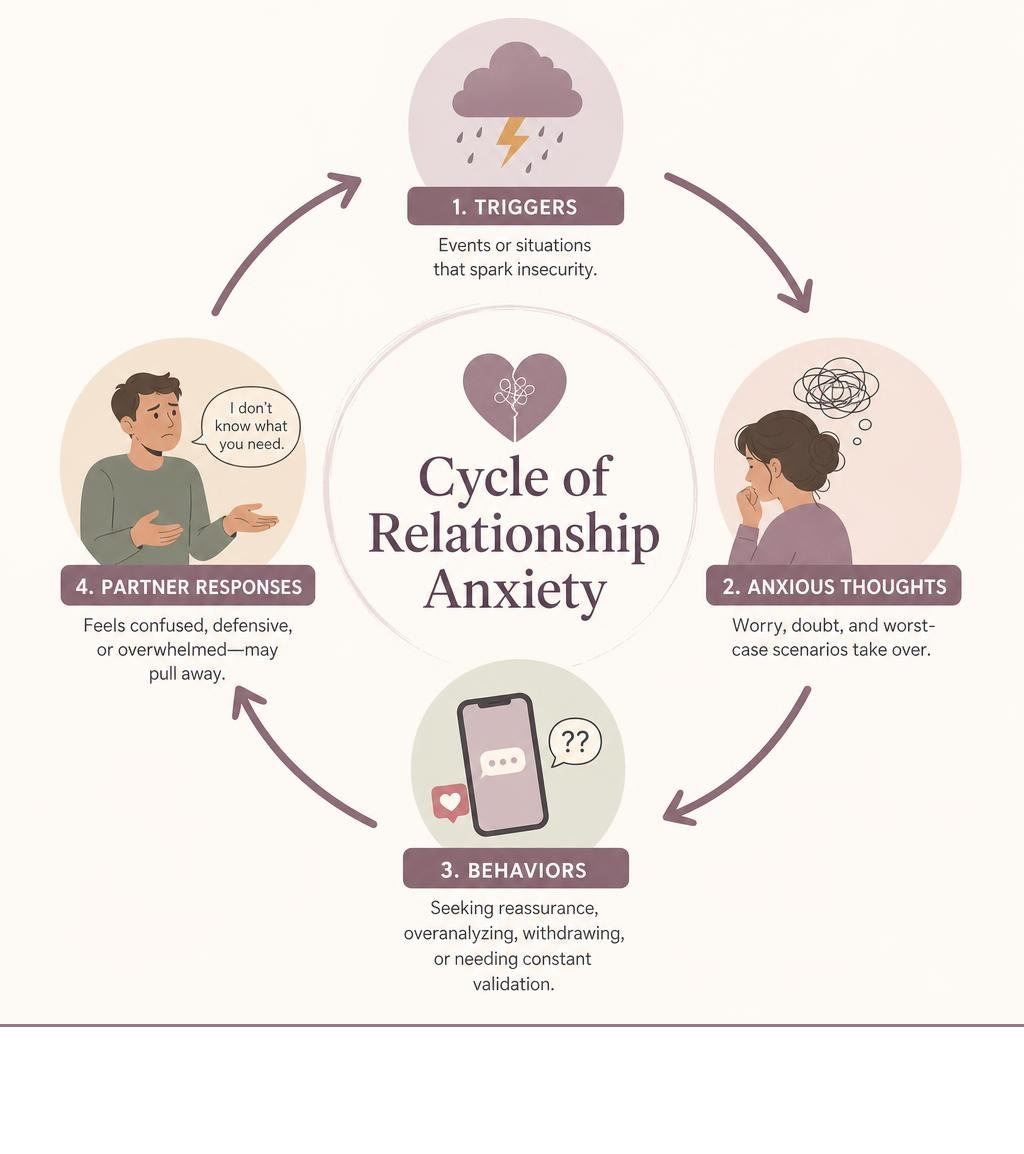
What is Anxiety in Romantic Relationships?
At its core, relationship anxiety is a persistent feeling of doubt, insecurity, and fear within a romantic partnership, even when there is no objective threat to the bond. If you have ever found yourself staring at a “read” receipt for forty-five minutes, constructing an entire mental narrative about how your partner is planning to leave you because they used a period instead of an exclamation mark, you have experienced relationship anxiety.
It is important to understand that relationship anxiety is not a formal clinical diagnosis. Instead, it is a bond-specific, biologically driven pattern of distress. It often manifests through two primary behavioral coping mechanisms:
- Excessive Reassurance-Seeking: Asking your partner variations of “Are we okay?” or “Do you still love me?” multiple times a day. While this provides a temporary sense of relief, it is a moving target: the relief fades quickly, and the urge to ask returns.
- Self-Silencing: Keeping your own needs, boundaries, or disagreements bottled up out of fear that speaking up will cause your partner to leave.
To help clarify how this differs from other mental health struggles, let’s look at how relationship anxiety compares to Generalized Anxiety Disorder (GAD):
Comparing Relationship Anxiety and Generalized Anxiety Disorder (GAD)
| Feature | Relationship Anxiety | Generalized Anxiety Disorder (GAD) |
|---|---|---|
| Primary Focus | The stability, safety, and future of the romantic bond. | Multiple daily life areas (finances, health, career, safety). |
| Clinical Diagnosis | Not a standalone clinical diagnosis. | A formally recognized clinical anxiety disorder. |
| Triggers | Partner’s tone, delayed texts, perceived emotional distance. | General life stressors, uncertainty, or no specific trigger. |
| Resolution Pathway | Relational repair, co-regulation, and attachment healing. | Individual cognitive reframing, somatic regulation, and therapy. |
For a deeper dive into how these patterns present clinically, you can read this Scientific research on relationship anxiety.
Recognizing the Signs of Anxiety in Romantic Relationships
Identifying anxiety in romantic relationships within yourself or your partner is the first step toward shifting the dynamic. Because our brains are wired to protect us from rejection, anxiety often masquerades as “just being careful” or “protecting the relationship.”
Common Signs of Relationship Anxiety
- Overthinking and Analysis Paralysis: Spending hours analyzing your partner’s micro-expressions, word choices, or physical distance to find “clues” about their true feelings.
- Insecurity and Constant Validation-Seeking: Feeling like you are only safe in the relationship when your partner is actively praising or validating you.
- Testing Behaviors (Sabotage): Purposefully creating distance, picking fights, or withdrawing to see if your partner will pursue you. This is a highly damaging cycle that erodes trust.
- Loss of Sense of Self: Completely merging your identity with your partner’s, abandoning your own hobbies, friendships, and boundaries to keep them happy.

When these behaviors take over, they crowd out the authentic connection needed to sustain a healthy partnership. To explore how to maintain your individuality while building closeness, check out our guide on Nurturing Connections: Building and Maintaining Healthy Adult Relationships.
Relationship Anxiety vs. Clinical Anxiety Disorders
It is entirely possible to experience relationship anxiety as part of a broader, diagnosed clinical anxiety disorder. When generalized anxiety, social anxiety, or separation anxiety are present, they naturally spill over into our romantic lives.
For example, high levels of social anxiety are closely linked to an increased fear of intimacy. This fear often predicts lower satisfaction with sexual communication, which in turn predicts lower overall sexual satisfaction. Furthermore, adults with diagnosed anxiety disorders are statistically less likely to be married and tend to have smaller social networks than those who are not socially anxious.
When clinical anxiety is present, minor relationship uncertainties feel like existential threats. To understand the underlying mechanics of how these clinical diagnoses interact with couples on a day-to-day basis, you can review this Scientific research on intimate relationships and anxiety.
Root Causes of Relationship Anxiety
Why does our brain turn a loving partnership into a source of panic? Relationship anxiety does not appear out of thin air. It is typically built on a foundation of childhood experiences, past heartbreaks, and personal insecurities.
You can learn more about the psychological origins of these fears in this Scientific research on attachment and anxiety.
Attachment Theory and Mismatched Styles
Our early relationships with parents or primary caregivers write the “blueprint” for how we expect love to work. This is the foundation of attachment theory:
- Anxious Attachment Style: If your caregivers were inconsistent, sometimes warm and attentive, other times distant or overwhelmed, you may have developed an anxious attachment style. As an adult, this translates into a hypervigilant nervous system that is constantly scanning your partner for signs of abandonment.
- Avoidant Attachment Style: If your caregivers were emotionally unavailable, you may have learned to rely solely on yourself. In adult relationships, closeness can feel suffocating, prompting you to pull away when things get too intimate.
- Secure Attachment Style: Built on consistent, reliable early caregiving, allowing adults to navigate closeness and independence with ease.
When an anxious attachment style pairs with an avoidant attachment style, it creates a classic “pursue-withdraw” cycle. The anxious partner pursues closeness, which triggers the avoidant partner to withdraw, which in turn spikes the anxious partner’s panic. Navigating these dynamics requires patience and self-awareness. If you are currently single or trying to understand your dating patterns, you might find our resource on Navigating Relationships and Single Life incredibly helpful.
Past Relationship Trauma and Insecurities
Even if you grew up with a secure attachment style, adult relationship trauma can disrupt your sense of safety. Experiences like:
- Infidelity or sudden abandonment by a former partner.
- Growing up in a household where conflict was explosive or silent.
- Deep-seated personal insecurities or low self-esteem that whisper, “You aren’t enough, and eventually, they will figure that out.”
These experiences create a protective shield of self-doubt and fear of rejection. To heal, we have to learn how to lower that shield and practice being open again. If you struggle to let your partner in, read our practical tips on How to Be Vulnerable.
How Anxiety Affects Romantic Relationships and Partners
Anxiety is never a solo experience in a relationship; it is a shared relational climate. Like a drop of food coloring in a glass of water, one partner’s anxiety eventually colors the entire relationship dynamic, impacting communication, emotional intimacy, and daily interactions.
To learn more about the relational perspective of living with these challenges, read this Scientific research on loving someone with anxiety.
The Impact on the Non-Anxious Partner
Living with an anxious partner can be deeply challenging, even for the most loving and patient spouses. Partners often experience:
- Emotional Contagion: Anxiety is highly contagious. When one partner is chronically anxious, the other partner’s nervous system often mirrors that stress, leading to shared irritability, anger, or sadness.
- Walking on Eggshells: The non-anxious partner may begin censoring their words, hiding minor problems, or changing their schedule to avoid triggering their partner’s anxiety.
- Caregiver Burnout: Over time, acting as the sole emotional anchor or constant “reassurance dispenser” leads to profound emotional depletion and resentment.
Indeed, academic studies show that on days when wives experienced higher anxiety, husbands reported a noticeable decline in relationship quality. Interestingly, wives with anxiety disorders perceived their husbands as having at least some influence on their anxiety on 60.5% of those high-anxiety days. This highlights just how interconnected couples truly are.
To break this cycle, partners must learn how to offer genuine validation without taking on the responsibility of fixing the anxiety. Discover how to build this skill in our article, How Validation Can Transform Your Relationships.
The Role of Partner Accommodation and Stonewalling
In an effort to be helpful, partners often engage in partner accommodation. This occurs when the non-anxious partner assists with avoidance behaviors or provides excessive, immediate reassurance to calm the anxious partner down.
While accommodation feels like a loving act of support in the short term, it actually reinforces relationship anxiety long term. It prevents the anxious partner from facing uncertainty and learning that they can survive the discomfort.
When the non-anxious partner eventually burns out from accommodating, they may swing to the opposite extreme: stonewalling. This is when a partner emotionally shuts down, withdraws, or ignores the anxious partner during a conflict. For an anxious partner, stonewalling feels like a terrifying abandonment, which only causes their anxiety to skyrocket. To understand this destructive pattern and how to stop it, read our guide on What is Stonewalling?.
Practical Strategies for Overcoming Relationship Anxiety
Overcoming relationship anxiety is not about never feeling anxious again; it is about changing how you respond to the anxiety when it arises. You can move from a place of panic to a place of secure connection by utilizing daily grounding tools, shifting your communication habits, and seeking professional support.
How to Manage Anxiety in Romantic Relationships Daily
When your nervous system goes into fight-or-flight mode, your logical brain shuts down. To regain control, you have to soothe your body first.
- Use the 333 Grounding Rule: When you feel an anxiety spiral starting, pause and name three things you can see, three things you can hear, and physically move three parts of your body (like rolling your shoulders or wiggling your toes). This pulls your brain out of the imagined future and back into the physical present.
- Distinguish Between Validation and Reassurance: Practice validating your feelings without demanding that your partner erase your uncertainty.
- Focus on Somatic Awareness: Instead of arguing about the “story” in your head, ask yourself, “Where am I feeling this in my physical body?” and take slow, deep breaths into that tension.
For more hands-on tools to calm your nervous system, explore our Emotional Regulation Tips.
Improving Communication and Connection
To build a secure bond, you and your partner need to learn how to talk about anxiety when you are both calm, rather than in the heat of a panic spike.
- Practice Active Listening: Ensure both partners feel heard and understood before trying to solve any problems.
- Share Primary Emotions: Instead of leading with secondary emotions like anger or blame (e.g., “You never text me back!”), share the vulnerable primary emotion underneath (e.g., “When I didn’t hear from you, I felt really anxious and worried that you were upset with me”).
- Speak Each Other’s Love Languages: Understanding how your partner gives and receives love can significantly lower relationship distress. Learn how to apply this concept in our article, Love Languages: Speaking the Dialect of Your Loved One’s Hearts.
Seeking Professional Therapy and Support
Sometimes, relationship patterns are too deeply ingrained to untangle on your own. Professional therapy offers a safe, structured space to heal attachment wounds and build healthy communication habits.
- Individual Cognitive Behavioral Therapy (CBT): Helps the anxious partner identify, challenge, and reframe negative thought patterns while building distress tolerance.
- Couples Therapy: Modalities like Emotionally Focused Therapy (EFT) help couples identify their negative cycles (like the pursue-withdraw loop) and build earned security through shared emotional repair.
At Stegall Counseling PLLC, we provide specialized support to help you navigate these exact challenges. You can explore our approach to healing on our Anxiety Therapy page. With compassionate, practical guidance, therapy can help you understand your anxiety patterns, communicate more clearly, and build a more secure connection in your relationship.
Frequently Asked Questions About Relationship Anxiety
Is relationship anxiety normal?
Yes, transient worry is a completely normal part of being human. It is natural to feel a bit nervous when you are falling in love, navigating a major life transition, or recovering from a past heartbreak.
However, relationship anxiety becomes problematic when it turns into persistent distress that interferes with your daily life, erodes your relationship satisfaction, or causes you to engage in self-sabotaging behaviors. If your anxiety is constant and preventing you from enjoying an otherwise healthy partnership, it is a sign that it is time to seek support.
Can relationship anxiety ruin a relationship?
Unaddressed relationship anxiety can act as a self-fulfilling prophecy. When you constantly worry that your partner is going to leave, your anxious behaviors (like constant interrogation, testing, or emotional withdrawal) can eventually overwhelm your partner, leading to the exact outcome you feared.
This cycle is heavily driven by an intolerance of uncertainty, which directly impacts dyadic satisfaction and consensus. You can read more about how these transdiagnostic factors influence couples in this Scientific research on uncertainty and dyadic adjustment.
How do I stop overthinking in my relationship?
Stopping the overthinking spiral requires a combination of physical grounding techniques, cognitive reframing, and self-compassion. Instead of trying to “force” your anxious thoughts to go away (which usually just makes them louder), practice observing them without judgment.
Remind yourself: A thought is just a thought, not a fact. If you struggle to make sense of intense, overwhelming feelings, check out our guide on Are My Emotions Valid? Understanding Emotional Regulation and Overwhelming Feelings.
Conclusion: Finding Peace and Connection Together
Managing anxiety in romantic relationships is a journey that requires patience, vulnerability, and the right tools. Whether you are working through early attachment wounds, learning to stop the reassurance loop, or trying to support an anxious partner without losing yourself, please know that you do not have to figure this out alone.
At Stegall Counseling PLLC, we are dedicated to helping individuals and couples build resilient, secure, and joyful relationships. Located in Indian Trail, NC, we offer a warm, relatable, and humor-infused approach to therapy, along with convenient in-network insurance options to make care accessible.
If you are ready to stop worrying and start connecting, we are here to help. Reach out to us today to Schedule a relationship counseling session.