

What You Need to Know About Rebuilding Trust After Betrayal
Rebuilding trust after betrayal is one of the hardest things a couple can face, but it is possible with the right approach.
Here is a quick overview of what actually works:
- Stop the bleeding first — establish safety and end the active crisis before doing deeper work
- Take full accountability — the person who broke trust must own it completely, without excuses
- Replace secrecy with radical transparency — proactively share information before being asked
- Answer questions repeatedly — even the same ones, without frustration or defensiveness
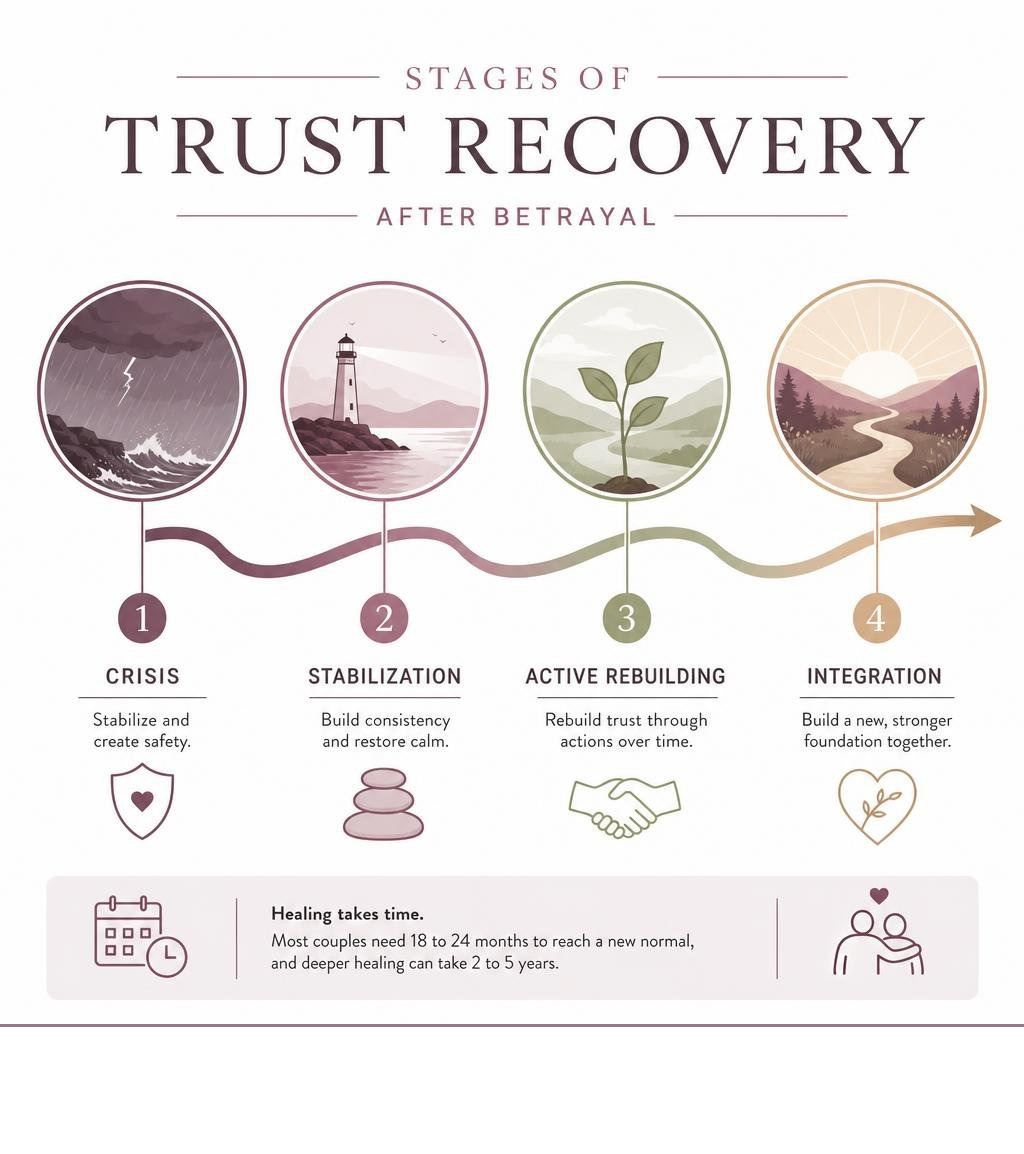
- Expect a real timeline — most couples need 18 to 24 months to reach a new normal, and deeper healing can take 2 to 5 years
- Get professional support early — couples who work with a therapist heal measurably faster than those who go it alone
Betrayal does not just damage a relationship. It can shatter your entire sense of safety in the world. Whether it was infidelity, financial secrecy, or an emotional affair, the pain is real, and so is the path forward.
Research shows that up to 40% of couples struggle significantly to restore trust after a major betrayal. Many feel stuck even after the harmful behavior has stopped. That is because trust is not rebuilt through apologies alone. It is rebuilt through consistent action over time at a biological, emotional, and cognitive level.
The good news? Many couples who do this work describe a relationship that feels more honest and intentional than what they had before.
At Stegall Counseling PLLC, the practice supports individuals and couples through the painful but often transformative process of rebuilding trust after betrayal. In this guide, you will learn what research says, what tends to work in real relationships, and what to watch out for along the way.
Understanding the Psychology of Broken Trust
To understand how to heal, we first have to look at what happens to our minds and bodies when trust is shattered. Trust is not a simple intellectual agreement. We do not just look at a partner, review their resume, and think, “Yes, you seem mathematically reliable.”
Instead, trust is a deeply felt sense of safety housed in the nervous system. When we trust someone, our biological default is co-regulation. We feel safe letting our guard down.
Betrayal shatters two core biological assumptions that keep us grounded in relationships:
- “I am your priority.”
- “I am safe with you.”
When these assumptions are broken, the partner who was betrayed experiences what clinicians call betrayal trauma. This trauma fundamentally changes how the brain perceives reality. It is like riding in a glass-bottom boat across a deep ocean. You feel completely protected from the dangers below until a sudden crack shatters the glass, plunging you into the cold water. Suddenly, everything feels like a threat.
This state is known as hypervigilance. The betrayed partner’s nervous system is constantly scanning for danger. A phone placed face-down on the counter, a late arrival from work, or a sudden change in tone is no longer just a minor annoyance; it feels like an existential threat. To explore this deeper emotional landscape, check out our comprehensive guide on Recovering from Betrayal Trauma: A Guide to Healing.
The Biological Impact of Betrayal
This is not just “all in your head.” Betrayal has a tangible, measurable impact on human biology. Neuroscientific research shows that social betrayal activates the exact same regions of the brain as physical pain, specifically the anterior cingulate cortex and the amygdala.
When your trust is broken, your body reacts as if it has been physically injured.
This biological alarm system triggers a massive flood of stress hormones:
- Cortisol levels spike, which can lead to chronic fatigue, sleep disturbances, weight changes, and “brain fog.”
- Adrenaline surges, keeping the body in a perpetual state of fight, flight, or freeze.
- The nervous system struggles to settle, making it incredibly difficult to relax, concentrate, or feel emotionally secure.
As noted in a landmark article on Once Broken, How Can Trust Be Restored in a Relationship? | Psychology Today , mistrust is heavily driven by these biological currents of anger and fear. Expecting a betrayed partner to simply “choose to trust” or “let the past go” is biologically unrealistic. Their nervous system has to physically unlearn the danger response, which requires time, safety, and consistent behavioral proof.
Evidence-Based Steps for Rebuilding Trust After Betrayal

If “just moving on” doesn’t work, what does? Rebuilding trust is a systematic process. It is a journey of small, daily actions rather than grand, sweeping gestures.
Think of it like repairing a house after a catastrophic storm. You cannot start painting the bedrooms while the roof is still collapsed and the living room is flooded. You have to follow a sequence: stop the bleeding, stabilize the structure, and then build a new foundation.
Here are the evidence-based steps to guide you through this process, inspired by the clinical wisdom shared in Rebuilding Trust After Betrayal in Marriage: Steps Toward Healing .
Step 1: Radical Transparency and Proof of Work
For the partner who broke trust, “not messing up” is not enough. A common mistake is believing that if you simply avoid doing the bad thing again, trust will return. But to a hypervigilant nervous system, silence feels terrifying. After being blindsided once, “nothing going wrong” can actually trigger anxiety because the betrayed partner is waiting for the other shoe to drop.
Instead, you must replace your old system of secrecy with a system of radical transparency. We call this “proof of work.”
This means proactively sharing your life, thoughts, and schedule before your partner has to ask. It includes:
- Sharing calendars and locations without being prompted or acting defensive.
- Proactively offering updates (e.g., “My meeting ran 15 minutes late, so I’m leaving the office now. Here is a photo of the traffic.”).
- The Counterintuitive Move: Sharing your moments of weakness before they turn into actions. If you feel an urge to slide back into old habits, or if you are struggling with shame, tell your partner. Showing them your internal landscape builds safety far faster than presenting a polished, perfect exterior.
By opening up your life completely, you demonstrate that you have nothing left to hide. For more tips on cultivating healthy habits of connection, see our guide on Nurturing Connections: Building and Maintaining Healthy Adult Relationships.
Step 2: Practicing Validation and Emotional Presence
The actual engine of trust repair is not the apology itself. It is your ability to stay present with your partner’s pain.
When a betrayed partner is triggered, they will often ask the same questions dozens of times. They might bring up the betrayal at unexpected times, raise their voice, or withdraw.
The natural response for the partner who broke trust is to get defensive, explain their intentions, or try to rush the conversation to a resolution. This defensiveness is often driven by shame. But defensiveness acts as a barrier to healing.
To rebuild trust, you must practice what we call “One-Way Repair.” In the early and middle stages of recovery, accountability flows primarily from the betrayer to the betrayed. You must learn to sit in the room, look your partner in the eyes, and validate their feelings.
Instead of saying:
- “I already apologized for that a hundred times!”
- “You’re just trying to punish me.”
Try saying:
- “You are right to feel hurt and angry. It makes complete sense that you are questioning this.”
- “I am here, and I am listening. Tell me more about what you are feeling right now.”
Staying present with the weight of the pain you caused without collapsing into shame or lashing out in anger is the single most powerful way to co-regulate your partner’s nervous system. To learn how to master this skill, read our article on How Validation Can Transform Your Relationships.
Establishing Clear Boundaries for Rebuilding Trust After Betrayal
Boundaries are the guardrails that keep a relationship on the road during recovery. However, a common misconception is that the betrayed partner must set all the rules. In reality, the most effective boundaries are those initiated by the partner who broke trust. This shows self-regulation and a proactive commitment to safety.
A great framework to use for daily check-ins is the FANOSS system, which stands for:
- Feeling (What emotions am I carrying right now?)
- Affirmation (What do I appreciate about you or our progress?)
- Needs (What do I need from you or myself today?)
- Ownership (What mistakes or struggles do I need to own?)
- Struggles (Where am I feeling tempted or overwhelmed?)
- Safety (What boundaries do we need to reinforce today?)
Establishing clear boundaries also means agreeing on digital privacy, social media use, and contact with outside individuals. When the betraying partner willingly limits their own freedom to protect the relationship, it acts as a powerful deposit into the trust bank. Learning to navigate this level of openness requires a willingness to drop our shields; you can explore this further in our guide on How to Be Vulnerable.
Managing Triggers and Avoiding Stonewalling
Setbacks are a normal part of the healing process. A song on the radio, a specific location, or an anniversary date can trigger emotional flooding in an instant. When flooding occurs, the brain’s rational center shuts down, and the survival brain takes over.
During these moments, it is incredibly easy for couples to fall into destructive communication patterns. The betrayed partner may lash out in intense anger, while the betraying partner might retreat into silence, shut down, or physically leave the room. This withdrawal is known as stonewalling, and it is highly toxic to the repair process.
To manage triggers safely:
- Acknowledge the flood: Recognize when you or your partner are becoming biologically dysregulated (increased heart rate, shallow breathing, muscle tension).
- Take a structured pause: Agree beforehand on a signal to pause the conversation. Say, “I am feeling flooded and I want to stay present for this, but my body is shutting down. Let’s take a 20-minute break to calm our nervous systems, and then we will sit back down.”
- Practice self-soothing: Use deep breathing, a brief walk, or mindfulness during the break. Do not use the time to ruminate or build a case against your partner.
- Return and repair: Always come back to the conversation at the agreed time to ensure the issue is not swept under the rug.
To understand why shutting down is so damaging and how to break the cycle, read our in-depth exploration: What is Stonewalling?.
Common Mistakes to Avoid in the Healing Process
Even with the best intentions, many couples accidentally stall their own recovery by falling into common traps.
| Healthy Repair Behaviors | Common Recovery Mistakes |
|---|---|
| Radical, proactive transparency | Piecemeal disclosure (sharing details only when forced) |
| Validating the partner’s pain and anger | Defensiveness, explaining intentions, or blame-shifting |
| Patience with a non-linear timeline | Rushing the partner to “get over it” or move on |
| Focusing on empathy for the partner’s pain | Collapsing into self-focused shame and self-pity |
| Establishing clear, self-regulated boundaries | Expecting the partner to police your behavior |
One of the most destructive mistakes is piecemeal disclosure, often called “trickle truth.” This is when the partner who broke trust only reveals details as they are uncovered by the other partner. Every time a new detail emerges, it resets the trauma clock back to zero. The betrayed partner feels as though they are being lied to all over again, which completely erases any progress made. Full disclosure, ideally guided by a professional, is essential.
Another major hurdle is the betrayer’s relationship with shame. Shame is a self-focused emotion (“I am a terrible person”), whereas guilt is other-focused (“I did a terrible thing, and I want to fix it”). When a betrayer is consumed by shame, they will often sprint past hard conversations, collapse into self-pity, or lash out defensively to protect their fragile ego.
As highlighted in the clinical insights from Rebuilding Trust: Signs of Genuine Change After Betrayal , true change requires humility and internal motivation. A partner who is genuinely changing will take full responsibility for their actions without shifting blame to the relationship, stress, or their partner’s past behavior.
The Danger of Rushing the Timeline for Rebuilding Trust After Betrayal
Perhaps the most common mistake is expecting too much, too soon. The partner who broke trust often wants to sprint back to “normal” because staying in the wreckage is uncomfortable. But you cannot rush a biological process.
The nervous system of the betrayed partner requires consistent, repetitive safety over a long period to physically rewire itself.
On average, couples need 18 to 24 months of consistent effort to establish a functional “new normal” after a major betrayal. Deeper emotional repair and integration often take 2 to 5 years. Trying to skip ahead to forgiveness before processing the grief and anger is like trying to put a bandage over an infected wound; it will eventually fester.
During this long timeline, couples often need guidance on what to share, when to share it, and how to avoid turning disclosure into more harm. For help thinking through the line between useful honesty and overwhelming detail, read Therapy Talks: TMI or Key to Connection?.
Frequently Asked Questions about Rebuilding Trust
Navigating the aftermath of a broken relationship brings up a lot of questions. Here are some of the most common questions we hear from couples in our therapy room.
How long does it typically take to rebuild trust after infidelity?
As a general rule, expect the acute crisis phase to last about 3 to 6 months. During this time, emotions are highly volatile, and the focus should be on stabilizing the relationship and establishing basic safety.
The active rebuilding phase typically spans 6 months to 2 years, where consistent behaviors, radical transparency, and open communication begin to slowly lower the betrayed partner’s hypervigilance.
The integration phase, where the betrayal is no longer the central focus of the relationship but rather a scar that has healed, can take an additional 1 to 3 years. Total recovery commonly takes 18 to 24 months for a new normal, and 2 to 5 years for deep, lasting repair.
Can a relationship truly be stronger after betrayal?
Yes, though it will never be the exact same relationship as before. The old relationship is gone, and trying to recreate it is usually a mistake.
However, many couples experience what psychologists call post-traumatic growth. By going through the painful process of dismantling old, unhealthy dynamics, practicing radical vulnerability, and rebuilding a foundation of absolute honesty, couples often build a “new” relationship that is far more resilient, intimate, and authentic than the one they had before.
For a deeper dive into how this transformation unfolds, you can watch discussions like the one featured in this video post: About to go live in our online community to talk about regaining your … .
When should a couple seek professional therapy?
You should seek professional support as early as possible, ideally within the first few weeks following the discovery of the betrayal. Trying to navigate this level of trauma alone often leads to repetitive, highly destructive fight cycles (the “Never Forget vs. Never Forgiven” loop) that can permanently damage the relationship.
Couples who engage in structured, specialized therapy show measurable improvements in trust far faster than those who attempt recovery alone. A trained therapist acts as a neutral guide, helping to regulate the room, structure the disclosure process safely, and teach the communication skills needed for true repair.
If you are ready to take that step, we specialize in helping couples navigate these exact storms. Learn more about our approach to Relationship Counseling & Life Transitions.
Conclusion

Rebuilding trust after betrayal is one of the most challenging, emotionally demanding journeys a couple can embark upon. It is a path marked by steep climbs, unexpected setbacks, and moments of profound vulnerability. But it is also a path that can lead to a level of relational depth, safety, and mutual respect that you might not have thought possible.
Remember: trust is not rebuilt in a single day, a single conversation, or through a single grand gesture. It is rebuilt in the quiet, consistent moments of daily life. It is rebuilt when you choose transparency over comfort, validation over defensiveness, and patience over the desire for a quick fix.
At Stegall Counseling PLLC, located in Indian Trail, NC, we provide a warm, relatable, and humor-infused approach to help you navigate your healing journey. We understand that this process is incredibly painful, but we also know that with the right support, healing is entirely within reach.
You do not have to carry this heavy burden alone. If you are ready to begin the work of repairing your foundation and building a stronger, more honest future together, we are here to walk with you.
Schedule a consultation with Stegall Counseling PLLC today to learn how we can support your relationship’s recovery.