

The Ultimate Guide to Emotional Intimacy Building Exercises
You’re Not Alone If Your Relationship Feels Distant
Emotional intimacy building exercises are structured, repeatable practices that help couples feel genuinely close again, not just coexisting, but truly connected.
Here are the most effective ones to start today:
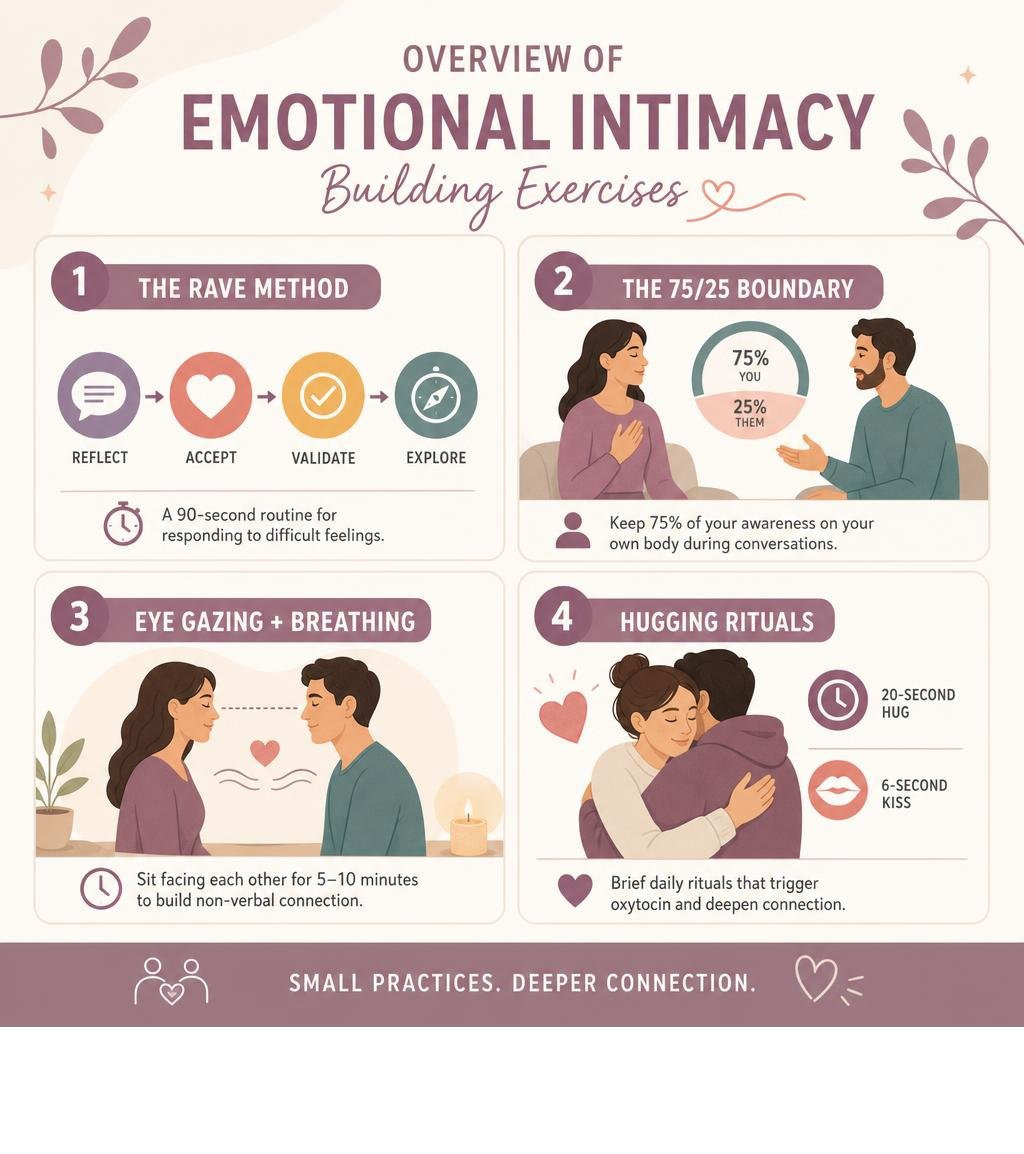
- The 75/25 Somatic Boundary: Keep 75% of your awareness on your own body during conversations to stay calm and regulated
- The RAVE Method: Reflect, Accept, Validate, Explore; a 90-second routine for responding to difficult feelings
- The “I Feel” Game: Share present-moment emotions using “I feel…” statements without explaining or fixing
- Eye Gazing and Synchronized Breathing: Sit facing each other for 5–10 minutes to build non-verbal connection
- The Third Chair: Ask “how does this affect us?” to protect the relationship as a shared entity
- The 20-Second Hug or Six-Second Kiss: Brief daily physical rituals that trigger oxytocin release
- Neurodiverse Adaptations: Use tools like a Feelings Wheel or color-coded consent cards for structured, sensory-friendly connection
You can share a home, a bed, and a schedule with someone and still feel like strangers. That quiet disconnection is one of the most common experiences couples have, and it rarely happens because of a single event. It happens through hundreds of small moments that slowly add up.
The good news? Connection can be rebuilt the same way it erodes: one small moment at a time.
Research backs this up. Couples who regularly practice emotional intimacy exercises report a 30% increase in relationship satisfaction over six months, and 70% experience improved communication and less conflict. These aren’t grand gestures. They’re simple, repeatable habits rooted in how your nervous system actually works.
At Stegall Counseling PLLC, we’ve guided many clients through the exact emotional intimacy building exercises covered in this guide. Our work focuses on helping people feel safe enough to be truly known by the people they love.
What is Emotional Intimacy and Why Does It Matter?
At its core, emotional intimacy is the experience of being genuinely known, accepted, and understood by another person. It is not just about proximity, living together, or even sharing a physical bed. True closeness requires a mutual willingness to drop your psychological armor and share your authentic inner world, including your fears, dreams, insecurities, and joys—while feeling safe from judgment or rejection.

In long-term relationships, emotional intimacy acts as the primary buffer against life’s inevitable storms. When you feel emotionally connected, your partner becomes a “secure base.” This sense of safety has profound physiological effects. When we feel securely connected, our nervous systems shift out of “fight-or-flight” mode and into a state of social engagement and relaxation.
This biological reality is why traditional communication tips often fail when couples try to use them during an argument. Standard advice tells you to use “I-statements” or mirror your partner’s words. But if your amygdala is screaming that you are under attack, your rational brain goes offline. Your brain’s survival center is about six seconds ahead of your logical neocortex. If you do not feel biologically safe first, no amount of clever communication phrasing will save the conversation.
To build that safety, we have to look at how we learn How to Be Vulnerable. Vulnerability is the bridge between two separate inner worlds. When one partner takes the risk to share a tender, unedited feeling and the other partner receives it with warmth and curiosity, it completes a “circuit of connection.”
According to pioneering Gottman research on emotional connection, relationship health is built or destroyed in micro-moments hundreds of times a day. These moments are “bids for connection”: a sigh, a look, or a comment about a book. Couples who stay together turn toward these bids 86% of the time, while those who eventually split only turn toward them 33% of the time.
To understand why we focus on somatic (body-based) exercises rather than just talking tips, look at how they compare:
| Traditional Communication Tips | Somatic & Relational Intimacy Exercises |
|---|---|
| Focuses heavily on cognitive scripts (“I feel X when you do Y”) | Focuses on nervous system regulation and physical sensations |
| Often treats the relationship like a software bug to be fixed | Prioritizes creating biological safety before problem-solving |
| Can feel clinical, rigid, or artificial during high stress | Works with real-time biological cues to co-regulate |
| Easy to weaponize or use defensively to “win” arguments | Encourages dropping defensive armor to show the tender self |
By practicing targeted emotional intimacy building exercises, we deliberately slow down our communication, lower our physiological stress, and trigger the release of oxytocin—the hormone responsible for bonding, trust, and security.
7 Transformative Emotional Intimacy Building Exercises to Try Tonight
If you are ready to shift your relationship from a state of polite cohabitation to deep, vibrant connection, you do not have to wait for a major milestone. You can start rebuilding your bond tonight.

Deepening your bond is an active, daily practice of Nurturing Connections: Building and Maintaining Healthy Adult Relationships. Here are seven highly effective, evidence-based exercises designed to help you and your partner step out of parallel living and back into shared warmth.
The 75/25 Somatic Boundary: Staying Grounded
Most of us enter difficult relationship conversations with 100% of our attention pointed outward. We scan our partner’s face for signs of disapproval, listen for flaws in their logic, and prepare our counter-arguments. This outward focus leaves us completely disconnected from our own bodies, making us highly susceptible to getting swept away by emotional storms.
The 75/25 Somatic Boundary is a self-regulation practice that rewrites this pattern. During any conversation—especially tense ones—commit to keeping 75% of your awareness inside your own body, leaving only 25% of your attention on your partner.
- How to practice it:
- Sit or stand comfortably. Before you speak or respond, take a quick internal scan.
- Notice your physical sensations: Is your jaw clenched? Is your chest tight? Are you holding your breath?
- Keep the majority of your mental energy focused on softening those physical areas of tension and keeping your breathing slow and deep.
- Listen to your partner with the remaining 25% of your attention.
By staying anchored in your own physical body, you prevent your nervous system from going into survival mode. This somatic grounding allows you to remain calm, present, and emotionally available, even when your partner is sharing something difficult.
The RAVE Method: A 90-Second Emotional Intimacy Building Exercises Routine
When our partners share vulnerable or uncomfortable feelings, our natural instinct is to defend ourselves, explain our intentions, or rush in to “fix” the problem. Unfortunately, this immediately shuts down vulnerability.
The RAVE Method is a structured, 90-second response protocol designed to create instant emotional safety. It is adapted from leading relationship frameworks like those found in How to Build Emotional Intimacy: 5 Exercises You Can Try Tonight. It stands for:
- R – Reflect: Repeat back what you heard your partner say in your own words, without adding your own spin. (e.g., “I’m hearing that you felt incredibly lonely and overwhelmed when I stayed late at work this week.”)
- A – Accept: Accept their emotional reality as valid for them, even if you see the situation differently. Do not argue with their feelings. (e.g., “It makes complete sense to me that you would feel that way.”)
- V – Validate: Show your partner that you understand why they feel the way they do based on their experience. To learn more about how this works, read How Validation Can Transform Your Relationships. (e.g., “I know how much you value our evening time together, so of course my absence felt like a disconnect.”)
- E – Explore: Ask an open-ended question to invite them deeper, rather than offering a solution. (e.g., “What was the hardest part of that loneliness for you?”)
This simple 90-second loop stops the “content trap” (arguing over details) and immediately reassures your partner’s nervous system that they are seen, heard, and emotionally safe with you.
The “I Feel” Game: Vulnerability in the Present Moment
Many couples struggle with sharing their inner world because they do not know how to express emotions in real-time. Instead of sharing direct feelings, they share “thoughts disguised as feelings” (e.g., “I feel like you are ignoring me,” which is actually an accusation, not a feeling).
The “I Feel” Game is a highly effective way to practice clean, present-moment vulnerability without the clutter of past stories or defensive explanations.
- How to play:
- Sit facing your partner and make gentle eye contact.
- Take turns sharing simple, present-moment emotional states using the exact phrase: “Right now, I feel [emotion].”
- The rule is that you cannot explain, justify, or tell a story about why you feel that way. You can only name the raw emotion. (e.g., “Right now, I feel a little nervous,” or “Right now, I feel a warm sense of appreciation.”)
- The listening partner simply receives the statement with a nod or a gentle squeeze of the hand, without trying to fix, reassure, or challenge the feeling.
- If you want to dive deeper into when sharing becomes too much or how it builds bridges, check out Therapy Talks: TMI or Key to Connection?.
This game strips away the defensive narratives we build around our emotions and helps us share our raw, tender selves in a safe, structured environment.
Eye Gazing and Synchronized Breathing: Non-Verbal Emotional Intimacy Building Exercises
Sometimes, words get in the way of connection. When a relationship is strained, verbal communication can feel like a minefield. Non-verbal exercises allow couples to bypass the cognitive chatter and connect directly through their nervous systems.
Two classic non-verbal practices—originally rooted in Sensate Focus and eye gazing techniques—are Eye Gazing and Synchronized Breathing.
- How to do it:
- Sit comfortably facing each other, close enough that your knees are almost touching.
- Place your hands on each other’s hearts, or simply hold hands.
- Set a timer for 5 minutes.
- Maintain soft, gentle eye contact without speaking. If you feel the urge to laugh or look away, notice the discomfort, take a deep breath, and gently return your gaze to your partner’s eyes.
- As you look at each other, try to match the rhythm of your partner’s breathing. Inhale together, and exhale together.
This exercise actively stimulates the vagus nerve and activates the parasympathetic nervous system. It triggers a profound state of physiological attunement, melting away defensive barriers without a single word being spoken.
The Third Chair: Protecting the “Us”
In every relationship, there are three distinct entities: Partner A, Partner B, and the Relationship itself (the “Us”). During conflicts, we often slip into a polarized “Me vs. You” mindset, where one person has to win and the other has to lose.
The Third Chair exercise is a mental reframing technique that externalizes the relationship, treating it as a living, breathing entity that both partners are responsible for tending.
- How to practice it:
- When making decisions or navigating a disagreement, physically or mentally imagine a third chair in the room representing “The Us.”
- Ask yourselves: “What does the ‘Us’ need right now?” or “How will this decision affect the health of our relationship entity?”
- If Partner A wants to go to a noisy party and Partner B wants to stay home, instead of fighting over who gets their way, look at the third chair. The relationship might need a quiet, low-stress evening of connection, or it might need the fun of a shared social outing.
By shifting the focus from individual demands to the needs of the shared relationship, you move out of competition and back into a collaborative partnership.
The 20-Second Hug and Six-Second Kiss
We often underestimate the power of physical touch because we view it as either a casual greeting or a prelude to physical intimacy. However, intentional, non-sexual physical touch is one of the fastest ways to lower stress and build emotional security.
Research shows that physical touch, such as hugging, can reduce stress levels by up to 50% in couples. This is because prolonged physical contact triggers a massive release of oxytocin and dopamine while simultaneously lowering cortisol (the stress hormone). To make this work, the touch must be sustained long enough for your nervous systems to actually register the safety.
- The 20-Second Hug: Wrap your arms around your partner and hold them close for a full, uninterrupted 20 seconds. Do not just lean in; lean into each other, allowing your bodies to fully relax and support each other’s weight until you feel a physical “release” or sigh of relaxation.
- The Six-Second Kiss: Relationship experts recommend a daily six-second kiss. A quick peck on the cheek is logistical; a six-second kiss requires you to stop, turn toward each other, and be fully present in the moment. It is long enough to feel romantic and deliberate, communicating that your partner is wanted and desired.
These micro-rituals are simple ways of speaking your partner’s language, especially if you are navigating different Love Languages: Speaking the Dialect of Your Loved Ones Hearts.
Adapting Exercises for Neurodiverse Relationships
For neurodiverse couples—such as relationships where one or both partners have ADHD or Autism—standard emotional intimacy exercises can sometimes feel overwhelming or confusing. Sensory sensitivities, differences in emotional processing, and non-verbal communication styles need to be honored and accommodated.
- Use a Feelings Wheel: If identifying and naming emotions in real-time feels difficult or abstract, keep a printed Feelings Wheel nearby. This visual tool helps translate vague physical sensations into specific emotional words (e.g., shifting from “I feel bad” to “I feel overwhelmed and disconnected”).
- Implement Color-Coded Consent Cards: For physical touch exercises like Sensate Focus or mutual massage, use simple non-verbal cues. Green, yellow, and red cards can help a partner communicate their comfort levels without having to find the right words in the moment.
- Set Structured Connection Anchors: Spontaneous connection can sometimes cause anxiety for neurodivergent partners who thrive on routine. Schedule your intimacy exercises at the same time every week (e.g., “Sunday check-in at 7:00 PM”) so both partners have the mental space and capacity to show up fully.
Overcoming Common Barriers to Emotional Connection
Even with the best intentions, building emotional intimacy is rarely a smooth, obstacle-free path. We live in a world that constantly pulls our attention away from our partners, and our own personal histories can make vulnerability feel like a dangerous risk.
To build a lasting connection, we must recognize and actively address the most common barriers to emotional intimacy:
- Digital Distraction (“Phubbing”): Phone-snubbing is one of the most pervasive intimacy killers of our time. Research shows that the mere presence of a smartphone on a table—even if it is face down—significantly reduces the perceived depth and quality of a conversation.
- The “Content Trap”: Many couples spend their energy arguing over the logistics of a situation (who forgot to buy groceries, who is doing the bedtime routine) rather than addressing the underlying emotional need (feeling unsupported, lonely, or unappreciated).
- Fear of Rejection and Past Relational Wounds: If you grew up in an environment where your emotions were dismissed, or if you have experienced betrayal in past relationships, your brain will view vulnerability as a threat. You may habitually use avoidance or defensiveness to protect yourself from getting hurt again.
- The “One Cup of Coffee” Problem: Emotional distance rarely happens overnight. It happens when we stop noticing the small things—like making a cup of coffee for yourself without asking if your partner wants one. These daily micro-rejections signal to your partner’s nervous system that they do not matter to you.
To overcome these barriers, make your practice sustainable. Start small. Do not try to implement all seven exercises tonight. Pick one simple practice—like the 20-second hug or a tech-free evening—and commit to doing it consistently.
When to Seek Professional Support for Your Relationship
While practicing emotional intimacy building exercises at home is incredibly beneficial, there are times when self-directed exercises are not enough. It is important to recognize when your relationship needs the safety and structure of professional guidance.
We highly recommend seeking the support of a couples therapist if you experience any of the following:
- Emotional Flooding or Shutdown: If attempting these exercises consistently triggers intense anger, crying, or complete emotional withdrawal (stonewalling) in either partner.
- Persisting in Rigid, Painful Cycles: If you find yourselves having the exact same argument over and over again, unable to reach a resolution or feel heard, despite using communication tips.
- Unprocessed Trauma or Betrayal: If your relationship is recovering from a major rupture, such as infidelity, or if one partner has deep-seated trauma that makes emotional safety feel impossible to achieve on your own.
- A Complete Refusal to Participate: If one partner is eager to rebuild connection but the other consistently refuses to engage in any exercises or downplays the distance.
If you are looking for a structured, expert-led roadmap to jumpstart your connection, you can explore structured challenges, such as the 4-week intimacy challenge insights, which provide a progressive framework for rebuilding trust and closeness.
For couples in Indian Trail, NC, Stegall Counseling PLLC offers a warm, relatable, and humor-infused environment to help you unpack these patterns safely. We work with you to understand the biology of your unique connection, helping you move past defensive armor and back into a state of secure, lasting love.
Frequently Asked Questions About Emotional Intimacy
How long does it take to see results from emotional intimacy exercises?
While some exercises (like the 20-second hug or the RAVE method) can provide an immediate sense of relief and connection, rebuilding deep-seated emotional intimacy is a gradual process. For couples who practice these exercises consistently, noticeable shifts in overall relationship satisfaction, communication quality, and conflict reduction typically appear within 4 to 6 weeks.
Can emotional intimacy exist without physical intimacy?
Yes. Emotional intimacy and physical intimacy are distinct, though they are deeply interconnected and reinforce one another. Close friendships, family relationships, and certain platonic partnerships involve profound emotional intimacy without any physical or sexual dimension. However, in romantic relationships, a lack of emotional connection often causes physical intimacy to feel empty or transactional.
What is the difference between emotional intimacy and codependency?
Emotional intimacy involves two differentiated individuals who are genuinely known to each other while maintaining their own separate identities, personal boundaries, and emotional self-regulation. Codependency, on the other hand, is an unhealthy entanglement where one or both partners lose their sense of self, rely entirely on the other for their emotional state, and struggle to function independently.
Rebuild Your Connection with Stegall Counseling PLLC
If you have tried practicing these exercises and still feel like you are speaking different languages, you do not have to navigate this journey alone. Rebuilding emotional intimacy after years of parallel living or conflict takes time, patience, and often a professional guide to help you co-regulate and find your way back to each other.
At Stegall Counseling PLLC in Indian Trail, NC, we provide couples therapy and marriage counseling designed to help you break down your defenses and restore genuine warmth to your relationship. Our team brings a warm, relatable, and humor-infused approach to healing, ensuring you feel supported every step of the way. We also offer convenient in-network insurance options to make your care accessible.
Take the next step toward a deeper, more secure bond today. Schedule a relationship counseling session with us, and let us help you build a relationship where you are truly seen, heard, and loved.