

Step-by-Step Guide to Setting Relationship Boundaries
Why Setting Relationship Boundaries Can Help Transform Your Connections
If you’ve been searching for relationship boundaries setting help, start here:
- Identify your limits — Notice where you feel resentful, drained, or uncomfortable
- Name the boundary — Be specific about what needs to change
- Communicate clearly — Use calm “I” statements, such as “I need…” or “I’m not comfortable when…”
- Set a consequence — Decide what you’ll do if the boundary is crossed
- Follow through — Stay consistent so the boundary is taken seriously
Setting boundaries isn’t about pushing people away. It’s about knowing your limits and communicating them with honesty and respect.
That can be hard, especially if you’re used to people-pleasing, avoiding conflict, or putting others’ needs ahead of your own. Over time, those patterns can lead to resentment, anxiety, and emotional exhaustion.
The good news is that boundary-setting is a skill you can practice. Healthy boundaries can support:
- Stronger, more trusting relationships
- Less anxiety and emotional burnout
- A clearer sense of identity and self-respect
- Greater emotional safety with the people closest to you
Whether you’re dealing with a romantic relationship, family tension, or workplace burnout, boundaries help create healthier connections.
At Stegall Counseling, PLLC, we help individuals, couples, and families build practical, respectful boundaries when old patterns make change feel overwhelming. In this guide, we’ll walk you through the process step by step.
Must-know relationship boundaries setting help terms:
What Are Relationship Boundaries and Why Do They Matter?

At their core, boundaries are the invisible lines that define what is and is not okay in how people interact with you. They serve as the framework for how we want to be treated, as well as how we treat others.
Many people mistakenly view boundaries as barriers designed to shut people out. In reality, we like to think of them as dynamic drawbridges. A wall is permanent, rigid, and keeps everyone at a distance. A drawbridge, however, is flexible. It can go up for protection when safety is threatened, and it can lower to invite deep, meaningful connection when trust is established.
When we clarify our limits, we aren’t trying to control or change other people’s behavior. Instead, we are stating what we will do to protect our own mental, emotional, and physical well-being. This distinction is crucial: boundaries are about individual sovereignty and self-care, not relational warfare.
According to a comprehensive guide on how Healthy Boundaries Can Help Strengthen Relationships—Here’s How To Set Them, establishing these limits is a long-term strategy that protects you in the present while forming lasting, secure connections over time. When both partners know where they stand, they can interact from a place of mutual respect rather than anxiety or unspoken expectations.
The Core Types of Boundaries in Connections
To build a balanced life, we must look at the different areas where boundaries apply. Most relationship struggles don’t stem from a general lack of boundaries, but rather from a collapse in one or two specific domains.
Here are the six primary types of boundaries you should consider:
- Physical Boundaries: These govern your body, personal space, physical touch, and privacy. They define who can touch you, how you want to be greeted (a hug versus a handshake), and your need for physical distance.
- Emotional Boundaries: These separate your feelings and responsibilities from those of another person. Having healthy emotional boundaries means you can offer empathy and compassion without taking on the burden of managing someone else’s mood or “fixing” their pain.
- Intellectual Boundaries: These protect your thoughts, ideas, and beliefs. They ensure that even when you disagree with someone, your perspectives are respected and not met with belittling, mocking, or dismissive behavior.
- Time Boundaries: These safeguard your most limited resource: your hours. They involve saying no to overcommitting, protecting your sleep, setting aside dedicated personal time, and refusing to let others consistently waste your time.
- Financial Boundaries: These involve your money, assets, and spending habits. They include limits on lending money, agreements on shared expenses, and the freedom to make financial choices without feeling manipulated or obligated.
- Digital Boundaries: In our modern world, these are essential. They cover your digital availability, such as not replying to work emails after 6 p.m., turning off read receipts, refusing to share social media passwords, or asking for consent before posting photos of others.
To help visualize how these play out, consider this comparison table:
| Boundary Type | Healthy Expression | Unhealthy / Porous Expression |
|---|---|---|
| Physical | “I’m not comfortable with hugs right now; a wave is great.” | Tolerating unwanted touch to avoid making someone else uncomfortable. |
| Emotional | “I hear that you’re angry, but I cannot let you yell at me.” | Feeling personally responsible for keeping your partner happy at all times. |
| Intellectual | “We see this differently, and that’s okay. Let’s talk about something else.” | Changing your opinions or silencing your voice to keep the peace. |
| Time | “I can help you move for two hours on Saturday, but then I have to go.” | Saying yes to every favor until you are completely exhausted and resentful. |
| Financial | “I love you, but I’m not in a position to co-sign this loan.” | Lending money you cannot afford to lose because you feel guilty. |
| Digital | “I don’t check my work phone after hours unless it’s an emergency.” | Feeling obligated to reply instantly to every text, call, or DM. |
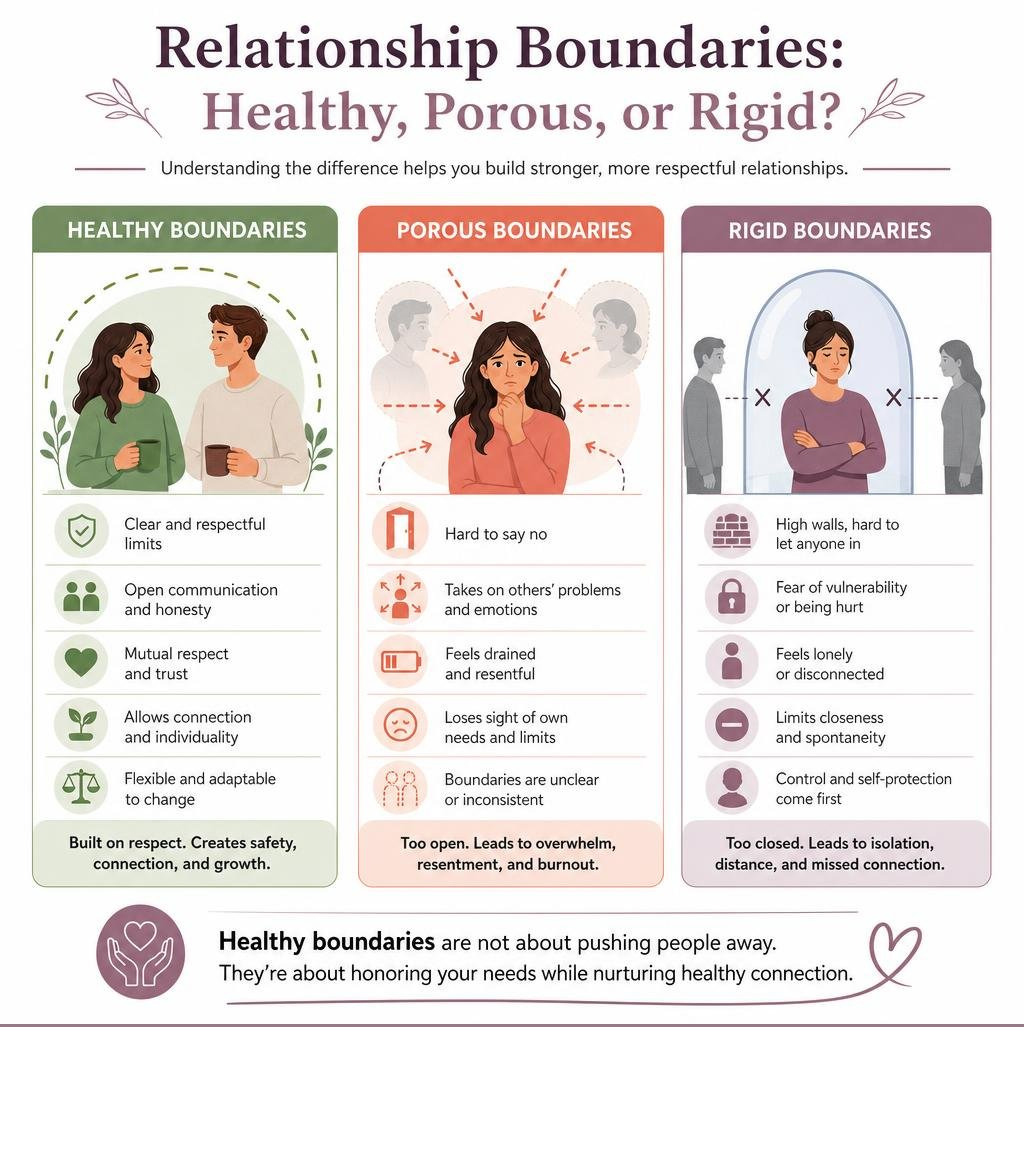
When boundaries are porous, we tend to over-give and lose our sense of identity, which often triggers significant anxiety in relationships. On the flip side, if boundaries are too rigid, we struggle to let anyone in, leading to isolation. The goal is to find a healthy, flexible middle ground.
Applying Boundaries in Romantic, Family, and Work Dynamics

How we apply these limits changes depending on the arena. Each type of relationship has its own unspoken rules and power dynamics:
Romantic Relationships
In romance, boundaries facilitate trust and cohesion. They help partners navigate the delicate dance between autonomy and dependence. Without clear limits, couples often slip into enmeshment, where one partner’s mood dictates the entire household’s emotional climate. Setting a boundary here might sound like: “I love spending time with you, but I need one evening a week to catch up with my friends.”
According to research highlighted in Setting Boundaries in Your Romantic Relationship | Psychology Today, relationships operate on both implicit and explicit rules. Making these rules explicit through boundary conversations actually increases feelings of safety and emotional intimacy.
Family Dynamics
Family systems are often where our boundary patterns are first written and where they are hardest to rewrite. Generational expectations can make setting limits feel like a betrayal. Enmeshment is common in families, where adult children are pressured to manage their parents’ emotional lives or tolerate intrusive questions about their career, dating life, or parenting choices.
As explored in Setting Healthy Boundaries in Family Relationships | ACP, learning to say, “I know you’re offering this advice because you care, but I need to make this decision on my own,” is essential for breaking unhealthy generational cycles.
Workplace Environments
Workplace boundaries protect you from professional burnout. They involve defining your capacity, limiting emotional labor, and keeping your professional and personal identities separate. This might mean declining to take on an extra project when your plate is full, or setting a policy that you do not answer calls after hours.
When Do You Need Relationship Boundaries Setting Help?
It is easy to intellectually agree that boundaries are important, but how do you know when your own boundaries are failing?
The body is often the first to know. Long before we consciously realize we need relationship boundaries setting help, our nervous system sends clear warning signs. If you find yourself constantly irritable, exhausted, or dreading interactions with certain people, your boundaries are likely being eroded.
In clinical psychology, we look at the difference between rigid and diffuse (or porous) boundaries. People with rigid boundaries keep everyone at a distance to avoid vulnerability, which often stems from a fear of rejection. Conversely, those with diffuse boundaries struggle to maintain a separate self. They absorb the emotions of those around them, say yes when they want to say no, and frequently experience a sense of self-abandonment.
If you are navigating the transition from single life to a relationship, or trying to understand your own relational patterns, assessing these limits is a vital step. You can read more about balancing independence and connection in our guide on Navigating Relationships and Single Life.
Recognizing the Signs of Boundary Erosion
If you aren’t sure whether you need to adjust your limits, ask yourself if you regularly experience any of the following:
- Pervasive Resentment: Resentment is the ultimate boundary alarm. It is the feeling of anger that arises when you feel taken advantage of, ignored, or unappreciated. If you find yourself thinking, “After everything I do for them, how could they treat me this way?” it is a sign that you have over-given and crossed your own limits.
- The “People-Pleasing” Habit: Do you automatically say yes to requests before checking if you actually have the time, energy, or desire to help? This instinct is often driven by a fear of conflict or abandonment.
- Apologizing for Having Needs: If you feel guilty for resting, asking for space, or expressing a differing opinion, your sense of self-worth has become tied to how useful you are to others.
- Tolerating Disrespectful Behavior: Allowing others to speak to you with sarcasm, yelling, or dismissive language because you want to avoid a confrontation.
- Emotional Burnout: Feeling completely drained by the emotional demands of your partner, friends, or family members, acting as an unpaid “free therapist” while your own needs go unmet.
When we ignore these signs, we participate in our own self-abandonment. Over time, this erodes our self-respect and makes it incredibly difficult to maintain secure, loving connections. For deeper insights into how to foster mutual respect in your daily life, explore our resource on Nurturing Connections: Building and Maintaining Healthy Adult Relationships.
A Step-by-Step Framework for Setting and Communicating Boundaries
When people search for relationship boundaries setting help, they often expect a magic phrase that will instantly make others respect their limits. However, setting boundaries is a five-step process that begins with internal clarity and ends with consistent action.
Step 1: Notice the Pattern and Tap into Somatic Awareness
Before you speak, you must feel. Your body holds vital information about where your boundaries live. We recommend practicing the 75/25 Somatic Boundary Technique: during a conversation, keep 75% of your awareness on your own physical sensations (your breathing, your chest tightness, your stomach) and only 25% on the other person.
If your chest tightens when a colleague asks you to stay late, that is your body telling you a boundary is about to be crossed. Notice the pattern of when and where you feel drained or resentful.
Step 2: Name the Boundary Specifically
Vague boundaries are impossible to enforce. Instead of saying, “I need you to respect my time,” define exactly what that looks like. A specific boundary is: “I need our meetings to start on time, and I will have to leave at the scheduled end time even if we aren’t finished.”
Step 3: Communicate Directly and Politely
When you are ready to speak, use clear, straightforward language. Avoid over-explaining, apologizing, or making excuses. You do not need a three-page essay to justify your needs. State your limit using “I” statements to minimize defensiveness.
As outlined in How to Set Boundaries and Build Better Relationships, keeping your tone calm and polite is key. You are not starting a fight; you are sharing the rules of engagement for a healthier relationship.
Step 4: Establish Realistic Consequences
A boundary without a consequence is merely a suggestion. A consequence is not a punishment or an attempt to control the other person; it is a statement of what you will do to protect your peace.
- Control attempt: “You need to stop texting me late at night!”
- Boundary with consequence: “I don’t reply to text messages after 9 p.m. If you text me after that, I will respond the following morning.”
Step 5: Follow Through with Consistency
This is the hardest part. If you set a boundary and then fail to enforce the consequence, you teach the other person that your limits are negotiable. Consistency is what builds trust, safety, and respect over time.
Practical Relationship Boundaries Setting Help Scripts
To help you put this framework into practice, here are a few simple, polite, and firm scripts you can use immediately in different scenarios:
- With a Partner: “I love you and want to hear about your day, but I’m feeling incredibly overwhelmed right now. I need 20 minutes of quiet time to unwind, and then I will be fully ready to listen and connect.”
- With a Family Member: “I appreciate that you want to help, but I’m not looking for feedback on my parenting choices. If you continue to criticize how I handle this, I’m going to pack up the kids and head home.”
- With a Friend: “I care about you deeply, but I don’t have the emotional capacity to process this situation tonight. Can we touch base on this over the weekend when I can support you better?”
- With a Colleague: “Thank you for thinking of me for this project. Looking at my current workload, I don’t have the capacity to take this on without my other tasks falling behind. Which of my current projects should we deprioritize to make room for this?”
Setting a boundary works best when it is paired with validation. Acknowledging the other person’s feelings while holding your line prevents unnecessary defensiveness. Learn more about this approach in our article on How Validation Can Transform Your Relationships.
Tailored Relationship Boundaries Setting Help for Couples and Families
In close-knit relationships, boundaries should be collaborative rather than combative. For couples, we recommend creating “relational agreements”—explicit, mutual rules that protect the relationship itself. This might include agreeing not to have serious discussions after 10 p.m. when you are both exhausted, or establishing a rule to pause a conversation for a 15-minute cool-down period if yelling begins.
With family systems, prepare for repetition. Families have long-standing roles, and when you step out of your assigned role by setting a boundary, the system will naturally try to pull you back in.
According to Setting Healthy Boundaries in Relationships – HelpGuide.org, maintaining limits with family members requires patience, self-compassion, and a willingness to tolerate their initial disappointment without rushing in to fix it.
Navigating Pushback, Guilt, and Resistance
When you start setting boundaries, some people will not like it. Those who benefited from your lack of limits may accuse you of being “selfish,” “cold,” or “difficult.” They might use guilt trips, silent treatments, or anger to pressure you into backing down.
It is vital to understand the difference between setting a boundary and engaging in a power struggle. A power struggle is an attempt to win, control, or force the other person to agree with you. A boundary is simply holding your line calmly, regardless of whether the other person likes it.
When met with resistance, keep these principles in mind:
- Expect Discomfort: Guilt is a natural side effect of breaking old people-pleasing habits. It does not mean you have done something wrong; it simply means you are doing something new.
- Stay Grounded: Do not argue, raise your voice, or get defensive. State your boundary once, calmly, and let your actions do the talking.
- Hold the Repair: If a boundary conversation gets heated, offer a path back to connection later. For example: “I’m going to step away because we’re both upset, but I love you and want to talk about this tomorrow when we are calmer.”
Frequently Asked Questions about Setting Boundaries
How do I set boundaries without sounding rude?
Setting boundaries is not rude; it is one of the kindest things you can do for a relationship because it prevents the slow buildup of resentment. To keep your boundaries polite yet firm, focus on using “I” statements, maintaining a calm and even tone, and avoiding accusatory language.
Instead of saying, “You always interrupt me and it’s incredibly disrespectful,” try: “I want to make sure I finish my thought. Please let me finish speaking, and then I’d love to hear your perspective.” You are simply stating your needs clearly without criticizing the other person’s character.
What if my partner gets angry when I set a boundary?
Anger is a common reaction to a new boundary, especially if your partner is used to having unlimited access to your time, energy, or resources. If your partner gets angry, prioritize emotional safety and de-escalation.
State calmly: “I see that you’re upset, and I want to talk about this, but I cannot continue this conversation while you are yelling at me. I’m going to take a walk, and we can check back in later.”
Be consistent. If you back down because of their anger, you teach them that anger is an effective tool to bypass your limits. If the anger escalates into controlling behavior, threats, or abuse, it may be time to seek professional support to evaluate the safety of the relationship.
Are boundaries selfish?
No. Boundaries are an act of self-care and mutual respect. Without boundaries, we eventually run out of emotional energy, leading to burnout, bitterness, and relational collapse.
By setting limits, you are taking responsibility for your own well-being so that you can show up fully, honestly, and lovingly in your connections. Boundaries do not destroy relationships; they preserve them by ensuring that both partners’ needs are valued.
Conclusion
Learning to identify, communicate, and maintain healthy limits is a lifelong journey. It requires self-compassion, patience, and practice. You do not have to rewrite all your relational patterns overnight. Start small, practice with low-stakes conversations, and celebrate your progress along the way.
If you find yourself repeatedly struggling with guilt, people-pleasing, or navigating intense conflict when setting limits, please know that you do not have to figure this out alone.
At Stegall Counseling PLLC, we provide a warm, relatable, and collaborative space to help you untangle old patterns, build self-worth, and establish boundaries that protect your peace. We offer therapy for anxiety, depression, trauma, grief, and relationship challenges to make your healing journey as smooth as possible.
Ready to create healthier boundaries in your relationships? Schedule a consultation with Stegall Counseling PLLC to learn how relationship counseling can support you at our Indian Trail NC office or online.