

A Comprehensive Guide to Relationship Dynamics Assessment Tools
When Something Feels Off: What Relationship Dynamics Assessment Tools Can Tell You
Relationship dynamics assessment tools are structured questionnaires and evaluations that help couples and individuals measure the health of their relationship across key areas like trust, communication, conflict, and intimacy.
Here is a quick overview of the most common types:
| Tool Type | Best For | Example |
|---|---|---|
| Clinical assessment | Therapy intake, deep evaluation | Gottman Relationship Checkup |
| Self-guided digital tool | Personal insight, general checkup | Gottman Relationship Adviser |
| Informal self-assessment | Quick snapshot, low-stakes reflection | Four Horsemen quiz |
| Therapist-administered | Crisis situations, structured treatment | C.A.R.E. Assessment |
You know something is off. Maybe you keep having the same argument. Maybe you feel more like roommates than partners. Or maybe things seem fine on the surface, but there is a quiet distance you cannot quite name.
That feeling is more common than most people admit, and it is exactly what relationship assessments are designed to help clarify.
When used carefully, validated relationship assessments can help turn vague concerns into clearer patterns. Instead of guessing whether the issue is communication, trust, conflict, intimacy, or emotional distance, these tools give couples and therapists a more structured way to understand what is happening.
The difference between a helpful assessment and a meaningless quiz comes down to one thing: scientific validation. Research-backed tools measure real, measurable patterns. Generic online quizzes often do not.
At Stegall Counseling, PLLC, we work with couples and individuals navigating these kinds of relational challenges by helping partners use relationship dynamics assessment tools as a meaningful starting point for growth, not just a score. In the sections below, we will walk through the most effective tools available, what they measure, and how to use your results.
Important relationship dynamics assessment tools terms:
- anxiety in romantic relationships
- couples communication skills training
- rebuilding trust after betrayal
Understanding Relationship Dynamics Assessment Tools

When couples start looking for ways to measure their bond, they often run into a wild west of internet quizzes. One day you are trying to figure out why your partner shuts down during disagreements, and the next, a pop-up quiz is promising to reveal your relationship health based on your favorite pizza toppings.
To make real progress, we have to separate informal self-assessments from clinically validated relationship dynamics assessment tools.
Informal quizzes are fun, low-stakes, and can sometimes spark a good conversation over dinner. However, they lack scientific rigor. They often rely on self-made frameworks that do not account for complex human behavior, and they tend to offer oversimplified solutions.
On the flip side, clinically validated tools are built on decades of peer-reviewed research and statistical analysis. For example, the Scientific Relationship Assessment Tool | Research-Based Analysis utilizes established psychological scales to offer an objective look at how you and your partner interact. These scientific tools do not just ask how you feel today; they evaluate long-term behavioral patterns, emotional habits, and cognitive frameworks.
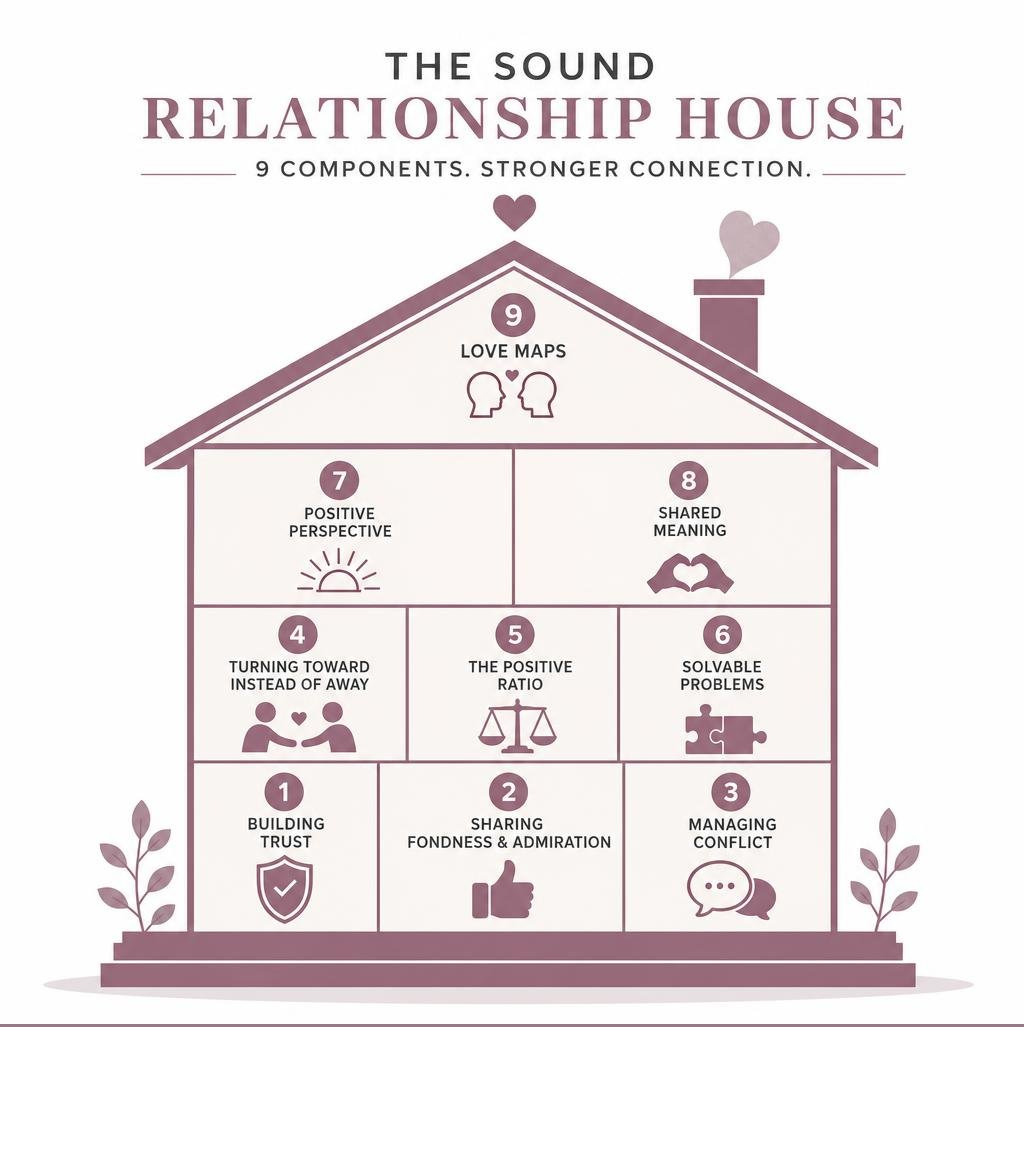
In our practice, we lean heavily on the Gottman Method, which is grounded in over 50 years of scientific research studying real couples. This approach is built around the “Sound Relationship House” theory, a blueprint for relational health that outlines how trust, commitment, and mutual respect form the foundation of a lasting partnership. By utilizing validated tools, we can move past guesswork and begin nurturing connections building and maintaining healthy adult relationships using data-driven insights.
Core Dimensions and Warning Signs in Partnerships
The most effective relationship assessments do not just give you a single “happiness score.” Instead, they break your partnership down into core dimensions. Think of it like taking your car in for a multi-point inspection; you want to know if the issue is the engine, the brakes, or just a loose gas cap.
A comprehensive evaluation typically measures these key areas:
- Trust and Commitment: The absolute bedrock. Do you feel safe? Can you rely on your partner to have your back, even when things get difficult?
- Intimacy and Friendship: This goes far beyond physical closeness. It measures how well you know each other’s inner worlds (what the Gottmans call “Love Maps”), how often you show fondness, and whether you turn toward each other’s emotional bids.
- Conflict Management: It is a myth that healthy couples do not fight. What matters is how you navigate disagreements. Do you collaborate on problems, or do you treat each other as the enemy?
- Shared Meaning: Do you share life goals, values, and a vision for the future?
When these core areas are out of balance, specific communication errors begin to creep in. Identifying these errors early is crucial because they act as silent relationship eroders. Through structured couples communication skills training step by step guide work, partners can learn to spot these breakdowns and replace them with healthy, constructive habits.
Clinical Relationship Dynamics Assessment Tools for Couples
If you decide to work with a professional, you will likely be introduced to clinical-grade tools. The gold standard in this category is the Gottman Relationship Checkup.
This is not a quick 10-question survey you complete during a commercial break. The standard questionnaire consists of 337 questions—and the fully comprehensive professional version can span up to 480 questions. It is designed to be completed by both partners individually to preserve privacy and prevent partners from influencing each other’s answers.
The assessment measures five key relationship areas:
- Friendship and intimacy
- Sex and passion
- Conflict management
- Shared meaning
- Trust and commitment
Because it is so thorough, it provides an incredibly detailed map of a couple’s strengths and challenges. The results are sent directly to your therapist, who interprets them within the context of your unique history. To understand how this clinical approach translates into real-world healing, you can read more about how Gottman Method couples therapy explained works in practice.
Self-Guided Relationship Dynamics Assessment Tools for Individuals
What if your partner is not ready to sit down for a clinical assessment, or you want to understand your own relational patterns first? You do not have to wait for joint therapy to gain deep, research-backed insights.
Individual assessment tools are highly valuable for identifying personal attachment styles and emotional triggers. Your attachment style, whether secure, anxious, avoidant, or disorganized, is forged in childhood and heavily dictates how you handle conflict and intimacy as an adult.
A fantastic example of an individual, research-informed framework is the C.A.R.E. Relationship Assessment. Grounded in Relational-Cultural Theory, the C.A.R.E. Relationship Assessment measures your subjective experience of the relationship across four distinct dimensions:
- Calm: Your nervous system regulation and sense of safety.
- Accepted: Whether you feel unconditional positive regard.
- Resonant: The presence of mutual, two-way emotional communication.
- Energized: Whether the relationship fuels you or leaves you depleted.
Taking a tool like this on your own helps you pinpoint exactly which areas of connection feel depleted, which can be incredibly empowering. It can also help you understand if what you are experiencing is general relationship stress or a deeper personal pattern, which you can explore further with our ultimate checklist for managing relationship anxiety.
Identifying Warning Signs and Red Flags
One of the greatest benefits of using standardized relationship dynamics assessment tools is their ability to detect subtle, toxic patterns before they cause irreparable damage.
In the Gottman Method, the most destructive conflict habits are referred to as the Four Horsemen of the Apocalypse. These are:
- Criticism: Attacking your partner’s core character rather than focusing on a specific behavior (e.g., “You always forget the dishes because you only care about yourself” vs. “I feel overwhelmed when the dishes are left in the sink”).
- Contempt: Speaking from a place of superiority, using sarcasm, mockery, or hostile humor. Contempt is the single greatest predictor of relationship breakdown.
- Defensiveness: Meeting a complaint with self-protection or cross-complaining to reverse the blame.
- Stonewalling: Shutting down, withdrawing, and physically or emotionally tuning out of the conversation. If you find yourself or your partner frequently disengaging during tough conversations, it is helpful to understand what is stonewalling and why it happens.
Beyond the Four Horsemen, specialized assessments are designed to detect more severe red flags, such as coercive control, gaslighting, and DARVO (Deny, Attack, and Reverse Victim and Offender). Coercive control is a continuous, pervasive pattern of behavior where one partner micromanages and limits the other’s daily freedom.
When trust has been severely damaged by these behaviors or by infidelity, the road back requires a structured approach. Understanding how to navigate this process is essential for couples committed to how to rebuild trust after betrayal 7 methods that guarantee results.
Choosing the Right Assessment for Your Partnership

Choosing the right tool depends entirely on your current situation and goals. If you are experiencing chronic conflict or recovering from a major betrayal, a self-guided online quiz is not going to cut it—you need the depth of a clinical, therapist-administered assessment. If you are simply looking for a tune-up or want to understand your own communication habits, an individual or self-guided digital tool is a great place to start.
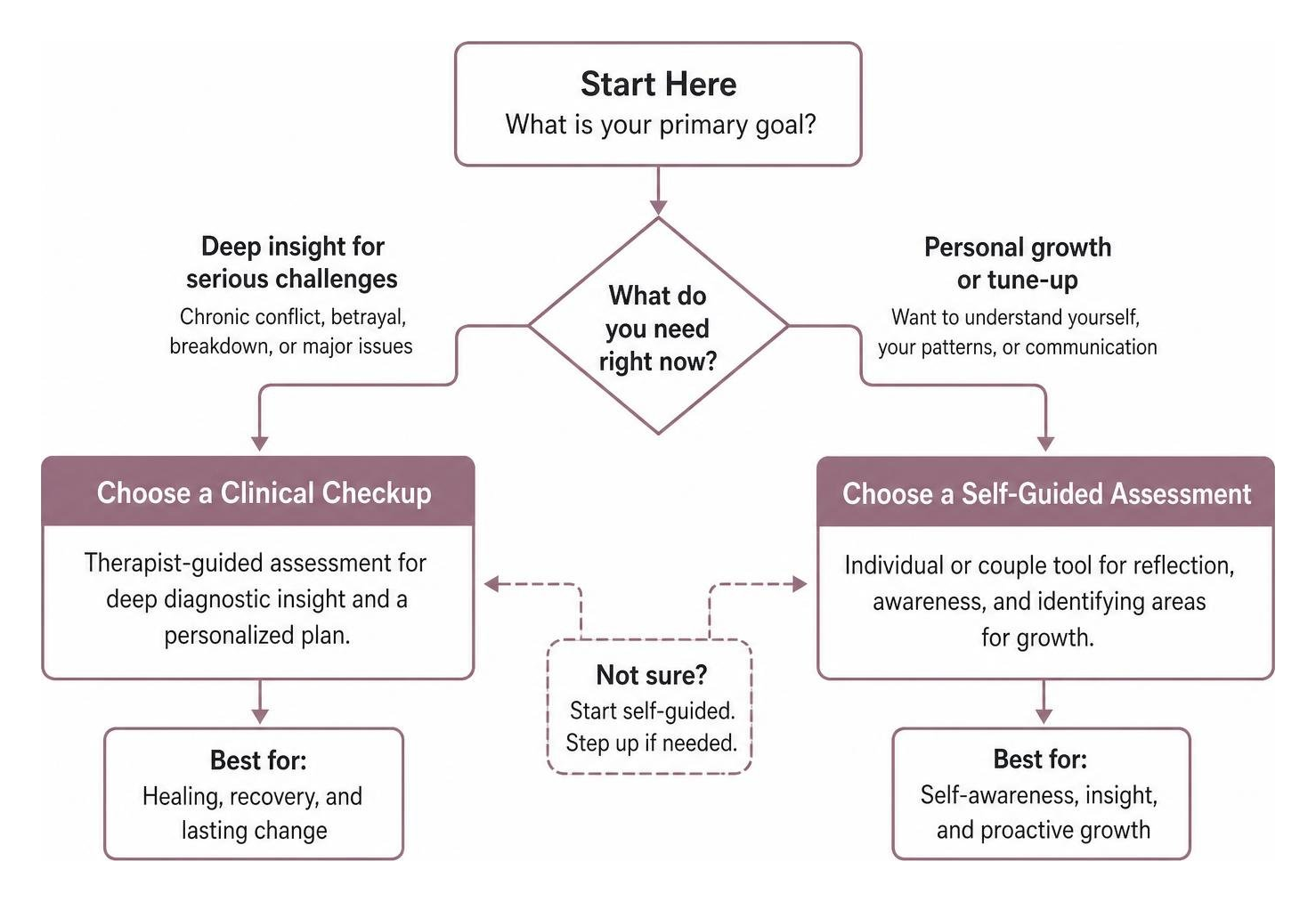
To help you decide, consider this comparison:
| Feature | Clinical Assessments (e.g., Gottman Checkup) | Self-Guided Assessments (e.g., C.A.R.E. or RPT) |
|---|---|---|
| Primary Goal | Deep diagnostic mapping for therapeutic intervention | Personal reflection, identifying growth areas |
| Who Takes It? | Both partners (individually and privately) | Can be taken individually or together |
| Time Commitment | 1 to 2 hours | 5 to 20 minutes |
| Oversight | Requires a licensed clinician to interpret results | Self-interpreted or guided by digital reports |
| Data Privacy | Strict clinical standards (HIPAA-compliant) | Often stored locally in-browser or on secure servers |
Regardless of where you are starting, our team at Stegall Counseling, PLLC in Indian Trail, NC, is here to help you make sense of these tools. We believe that looking at your relationship honestly shouldn’t feel like a clinical trial or a punishment. With a warm, relatable, and occasionally humor-infused approach, we can walk through your results together and build a practical roadmap for your future.
Frequently Asked Questions about Relationship Assessments
Navigating relationship tools can raise a lot of logistical and emotional questions. Here are some of the most common things couples ask us.
Can we take a relationship assessment individually?
Absolutely. You do not need your partner’s permission or participation to start understanding your relationship better. Taking an assessment like the Relationship Profile Test (RPT) or the C.A.R.E. assessment individually is highly valuable. It allows you to explore your subjective experience of the relationship without any external pressure.
These individual insights can help you identify where your personal boundaries lie, how your attachment style influences your reactions, and what specific areas of connection you feel are lacking. This personal clarity is incredibly useful, whether you bring it into individual therapy or use it to open a constructive dialogue with your partner later.
How accurate are scientific relationship assessments?
Scientific relationship assessments can be useful when they are built on validated frameworks and interpreted in the right context. They are not magic predictions, and they should not reduce a relationship to a single score. Instead, stronger tools look at repeated patterns in areas like communication, trust, conflict, intimacy, and emotional responsiveness.
For example, the Gottman Method is based on decades of research into how couples interact, especially during conflict. Rather than relying on an unsupported accuracy statistic, it is safer to say that research-informed assessments can help identify patterns that may be putting stress on the relationship. These tools are most reliable when used as conversation starters or alongside professional guidance, not as a stand-alone verdict on whether a relationship will succeed.
What should we do if our assessment scores are very different?
First, don’t panic! It is incredibly common for partners to have divergent scores on relationship assessments.
Rather than viewing different scores as a sign of failure, look at them as a valuable diagnostic opportunity. Divergent scores simply mean that you and your partner are experiencing the relationship differently. For example, one partner might feel that conflict management is going well, while the other feels completely unheard.
Discovering these gaps in perception is exactly what these tools are for. It gives you a concrete, neutral starting point to discuss your differing experiences with curiosity and empathy, rather than defensiveness.
Conclusion
Taking the first step to evaluate your relationship can feel intimidating, but you do not have to navigate it alone. Whether you are dealing with a major life transition, trying to break free from repetitive arguments, or simply wanting to strengthen your emotional intimacy, relationship dynamics assessment tools offer a clear, research-backed mirror to show you exactly where you stand.
At Stegall Counseling, PLLC, we specialize in helping couples and individuals in Indian Trail, NC and surrounding Union County communities unpack these dynamics. We offer a safe, warm, and highly supportive environment to help you turn your assessment results into real, lasting change.
If you are ready to stop guessing and start growing, we invite you to learn more about our approach to relationship counseling life transitions and take the next step toward a healthier, more connected partnership.