

When Money Stress Becomes Relationship Stress: What You Need to Know
Relationship financial stress therapy is a specialized approach that helps couples address both the emotional and practical sides of money conflict. Here is a quick overview of what it involves:
- What it is: A form of counseling that blends therapeutic and financial skills to help couples reduce money-related anxiety and conflict
- Who it helps: Couples arguing about spending, partners with mismatched money values, and individuals whose financial worry is affecting how they see their relationship
- How it works: Therapists help couples identify unconscious money beliefs, improve communication, and rebuild trust around financial decisions
- Why it matters: Research shows that financial worry is one of the leading predictors of relationship dissatisfaction and divorce
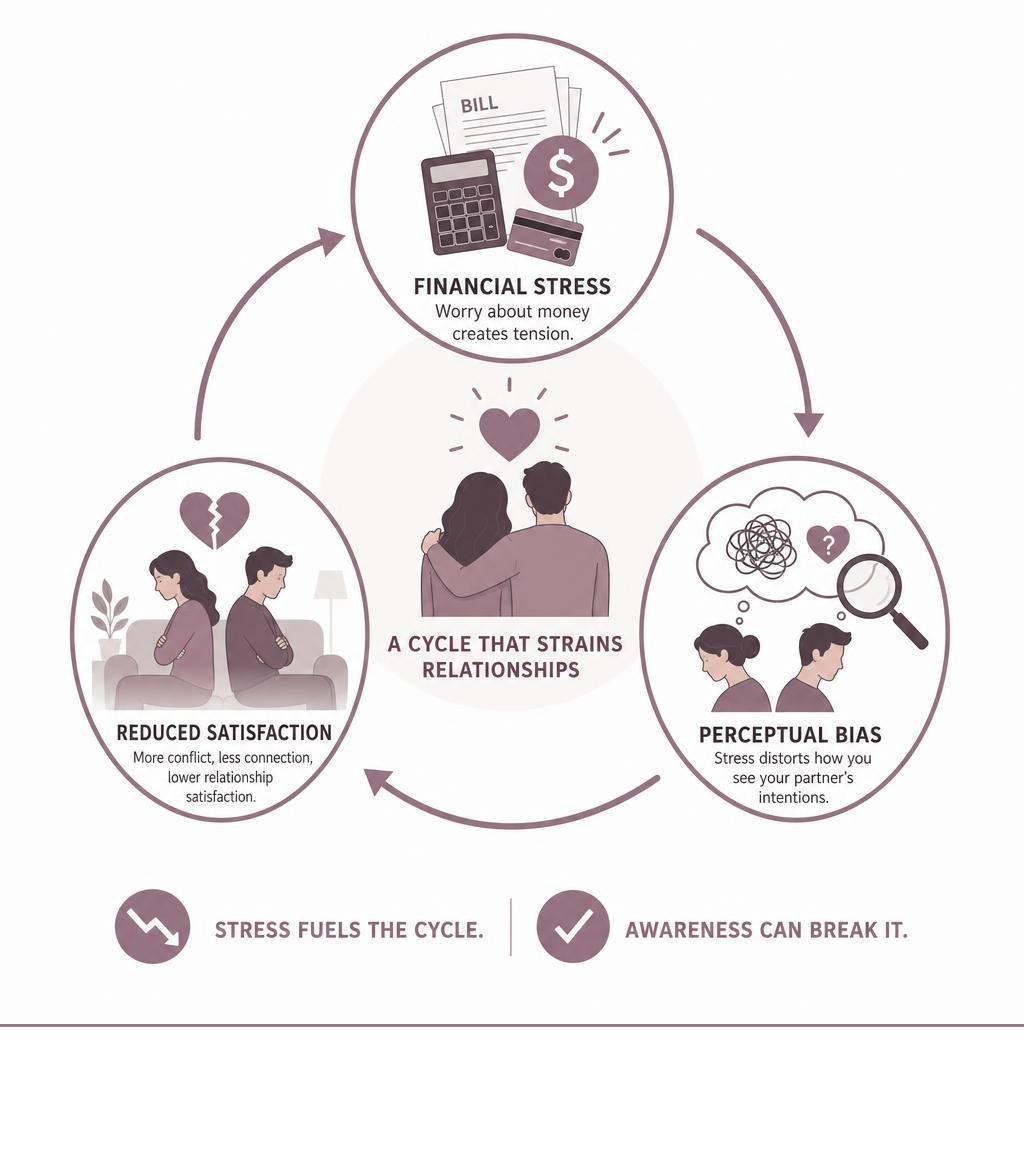
Have you ever noticed that when your bank account stress goes up, your patience with your partner goes down? You are not imagining it. According to the American Psychological Association, 66% of U.S. adults say money is a significant source of stress. And when that stress moves into a relationship, it does not just create arguments about bills. It quietly changes how you see your partner, how supported you feel, and how connected you stay.
The good news is that this is a well-understood problem with real, practical solutions.
Financial stress does not have to become relationship damage. Whether you and your partner are arguing about spending habits, carrying different levels of worry about the same bank account, or simply struggling to talk about money without tension, understanding what is happening underneath those conflicts is the first step toward changing them.
At Stegall Counseling, PLLC, we work with couples navigating exactly these kinds of challenges through compassionate, evidence-informed relationship financial stress therapy. In this guide, we will walk through how financial anxiety impacts relationships, why it distorts the way we perceive our partners, and what you can do about it together.
Relationship financial stress therapy terms to learn:
- anxiety in romantic relationships
- couples communication skills training
- rebuilding trust after betrayal
The Cost of Worry: How Financial Stress Impacts Romantic Relationships

When we think about money problems in a relationship, we often think about the math: not having enough cash to cover the rent, dealing with credit card debt, or arguing over a large purchase. However, the emotional toll of carrying that worry is often what does the most damage to romantic partnerships. Financial anxiety functions as a heavy, constant cognitive load that drains our emotional reserves and leaves us with less patience, less empathy, and less energy to invest in our partners.
Academic research shows that money conflicts are fundamentally different from other types of relationship disagreements. According to a study analyzed in Examining the Role of Financial Therapy on Relationship Outcomes and Help-Seeking Behavior , money discussions are among the most frequent sources of marital conflict, ranking high on the list of stressful topics for both husbands and wives. These disputes are often more pervasive, happen more frequently, and are far more likely to remain unresolved compared to other daily challenges.
When couples face major life changes: such as transitioning to a new career, welcoming a child, or buying a home: financial stress can amplify the normal friction of these milestones. Navigating these moments requires a strong foundation of teamwork, which you can read more about in our guide on Relationship Counseling Life Transitions. When financial worry is thrown into the mix, it acts as a major disruptor, turning exciting milestones into sources of deep relational dread.
The Difference Between Objective Income and Subjective Worry
One of the most surprising insights from relationship science is that the actual amount of money you make is not the primary driver of relationship conflict. Instead, it is your subjective worry: the repetitive, anxious thoughts and rumination about money: that causes the most harm.
A high-earning couple can experience the exact same level of relationship distress as a lower-income couple if one or both partners carry high levels of subjective financial anxiety. According to national data, between 40% and 52% of U.S. adults report being moderately or very worried about not having enough money to pay normal monthly bills. This worry is deeply personal. It is shaped by your childhood, your personality, and your individual sense of security.
In fact, research shows that partners within the same household often experience financial anxiety quite differently. In a sample of couples, 50% of the variance in financial worry was found to exist within the couples themselves. This means that even when sharing the exact same bank accounts and bills, one partner might be deeply panicked about the future while the other remains relatively calm. This gap in subjective anxiety can easily lead to misunderstandings, with one partner feeling dismissed and the other feeling micromanaged.
To explore how these differing perspectives develop and how to build a unified approach to money, you can read more about collaborative financial management in this resource on Financial Counseling for Couples in MN | Enrich Your Relationship .
Signs of Financial Strain in Couples
When financial stress begins to erode relationship quality, it rarely announces itself directly. Instead, it shows up in subtle changes in how you interact with each other. Here are the key signs that financial anxiety is taking a toll on your partnership:
- Frequent, High-Intensity Arguments: Conversations about small things: like buying a coffee or forgetting to turn off the lights: quickly escalate into intense arguments about respect, control, and security.
- Emotional Distance and Withdrawal: One or both partners stop sharing their feelings, fears, or future goals. Money talks are avoided entirely because they feel too painful or risky.
- The Silent Treatment and Avoidance: Partners begin hiding receipts, making secret purchases, or avoiding looking at bank statements together, leading to a breakdown in transparency.
- Loss of Intimacy: The physical and emotional closeness that keeps a relationship strong begins to fade as survival mode takes over.
If you notice these patterns in your own relationship, you are not alone, and your relationship is not a failure. It is simply reacting to a high-stress environment. You can learn more about identifying and managing these underlying anxieties in our Ultimate Checklist For Managing Relationship Anxiety.
The Invisible Filter: How Financial Anxiety Distorts Partner Perception

Have you ever noticed that when you are stressed about bills, your partner’s neutral behaviors suddenly look incredibly annoying or even hostile? If they are quiet after work, you might assume they are angry with you. If they make a harmless comment about the grocery bill, you might interpret it as a direct attack on your earning power.
This is not a character flaw: it is a documented cognitive response to stress. Financial worry acts as an invisible filter, distorting how we perceive our partner’s actions.
When we are under chronic stress, our cognitive function is physically impaired. Research shows that financial worry leads to lower cognitive performance, including worse memory, shorter attention spans, and a decreased ability to read social cues accurately. Because your brain is completely occupied by survival-focused thoughts about money, you have fewer mental resources left to process social interactions. As a result, you are far more likely to misinterpret your partner’s neutral or even supportive behaviors as negative.
Learning how to manage these physiological stress responses is a crucial part of protecting your relationship. For practical advice on calming your nervous system during these moments, check out our Emotional Regulation Tips.
The Truth and Bias Model in Relationship Dynamics
In relationship psychology, researchers use the “Truth and Bias Model” to understand how accurately we perceive our partners. Under normal circumstances, partners have a reasonable understanding of each other’s true intentions. However, financial worry heavily biases this model toward the negative.
Studies have shown that greater financial worry is directly associated with perceiving more negative relationship behaviors from a partner: even after controlling for the partner’s actual, self-reported behavior. In other words, even if your partner is behaving in a supportive, loving way, your financial anxiety can trick you into seeing them as unsupportive, cold, or critical.
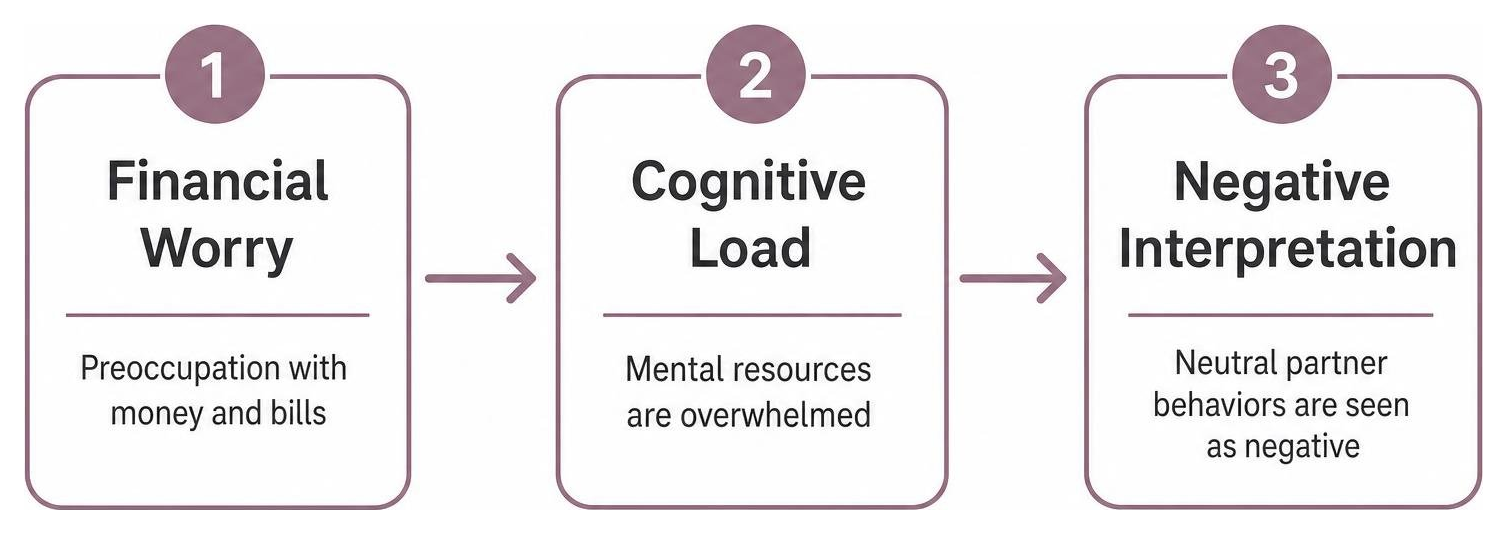
This perceptual bias has serious consequences:
- Biased Memory: You are more likely to remember past disagreements as highly hostile, even if they were relatively calm.
- Reduced Perceived Support: During a disagreement, a financially worried partner is highly likely to feel completely unsupported, misunderstood, and unvalued, regardless of the gentle language their partner actually uses.
- Erosion of Satisfaction: Because your perception of your partner’s behavior is more strongly linked to your overall relationship satisfaction than their actual behavior, this bias can quickly make you feel unhappy in an otherwise healthy relationship.
To counter this bias, couples must learn the art of emotional validation and active listening. By learning to validate each other’s feelings before trying to solve the financial problem, you can clear away the fog of anxiety. Discover how to practice this in our article on How Validation Can Transform Your Relationships.
How Relationship Financial Stress Therapy Can Help
When money arguments become a constant loop, traditional financial planning is rarely enough. You can create the most perfect budget in the world, but if you do not address the underlying emotional triggers, the arguments will continue. This is where relationship financial stress therapy comes in.
This specialized form of therapy integrates psychological and relational counseling with an understanding of personal finance. It provides a structured, safe space where couples can explore the emotional weight of money without fear of judgment or blame.
Leading researchers in this field, such as Kristy Archuleta | UGA FACS , have shown that addressing both the emotional and practical sides of money issues leads to significantly better relationship outcomes. By combining therapeutic models with practical communication tools, couples can lower their acute anxiety and learn to make collaborative financial decisions.
At Stegall Counseling, PLLC, we help couples identify where their individual anxieties end and where their relationship dynamics begin. If you find that financial worry is triggering deeper patterns of generalized anxiety, you may also benefit from our specialized Anxiety Therapy to help ground your nervous system.
Uncovering Childhood Money Stories and Scripts
One of the first steps in relationship financial stress therapy is exploring your family history with money. We all carry unconscious, deeply ingrained beliefs about money that we developed during childhood. In financial therapy, these are known as “money scripts.”
These scripts are highly resistant to change because they were forged during emotionally charged childhood events. According to research published in Integrating Financial Therapy within Family-Owned Businesses: A Theoretical Case Vignette with Recommended Strategies for Consulting with Copreneurs , there are four primary money scripts that dictate adult financial behavior:
- Money Avoidance: Believing that money is dirty, bad, or the source of all evil. Individuals with this script may avoid looking at bank statements, ignore bills, or feel guilty about accumulating wealth.
- Money Vigilance: Believing that money should be saved, monitored, and protected. While this leads to organized financial habits, extreme vigilance can cause intense anxiety about spending even small amounts of money, leading to a rigid lifestyle.
- Money Worship: Believing that more money is the key to happiness and solving all of life’s problems. This can lead to overworking, taking on excessive debt, or prioritizing career over relationship connection.
- Money Status: Equating self-worth with net worth. Individuals with this script often buy highly visible, luxury items to project an image of success, sometimes making uncoordinated or secret purchases that strain the household budget.
When a partner with a Money Vigilance script marries someone with a Money Avoidance or Money Status script, conflict is almost guaranteed unless they learn to understand each other’s underlying beliefs. Therapy helps you trace these scripts back to your childhood, allowing you to see your partner’s financial habits not as an attempt to hurt you, but as a survival strategy they learned long ago.
Fostering Financial Intimacy and Shared Values
Beyond managing budgets, the ultimate goal of relationship financial stress therapy is to build “financial intimacy.” This is the ability to speak openly, honestly, and lovingly about money without triggering your partner’s survival defenses.
Our ability to talk about money is directly tied to our autonomic nervous system and our attachment styles. When we feel threatened by a financial conversation, our body goes into a fight, flight, or freeze response. Our stomach tightens, our heart rate increases, and our brain prepares for battle. In this state, productive communication is impossible.
Through therapy, couples learn to create a safe emotional environment. This allows them to look at their financial reality through a lens of compassion rather than criticism. By aligning their spending and saving habits with their shared core values: rather than arbitrary rules: they can build a sense of shared purpose.
Practical Strategies to Manage Financial Stress Together
To help transition your relationship from conflict to collaboration, it is helpful to look at how your daily communication patterns might be keeping you stuck. The table below highlights the difference between reactive, stress-induced communication and healthy, collaborative communication:
| Unhealthy Financial Communication | Healthy, Collaborative Financial Communication |
|---|---|
| Harsh Startups: Bringing up a financial mistake immediately with blame (“Why did you spend so much on groceries again?”). | Soft Startups: Scheduling a calm, dedicated time to talk (“Hey, let’s look at our budget this weekend over coffee.”). |
| Mind Reading & Assumptions: Assuming your partner’s quietness or spending is an act of defiance or laziness. | Perception Checking: Asking for clarification (“I noticed you’ve been quiet since we looked at the bills. Are you feeling stressed?”). |
| Financial Secrecy: Hiding purchases, credit cards, or bank accounts to avoid an argument. | Radical Transparency: Sharing accounts, debts, and spending habits openly without fear of punishment. |
| Focusing on the Math Only: Demanding a partner cut back on spending without understanding what that spending represents to them. | Focusing on the Meaning: Exploring the emotional need behind the money behavior (e.g., security, freedom, or comfort). |
Implementing these healthy communication habits is a powerful way to build a resilient bond. For a deeper dive into establishing these patterns, explore our guide on Nurturing Connections Building And Maintaining Healthy Adult Relationships.
Here are three practical steps you can start taking at home today to reduce financial tension:
- Practice “Perception Checking”: Before you react to your partner’s behavior, pause and ask yourself: “Is my interpretation of this action being colored by my own financial anxiety?” If you are unsure, ask your partner directly using neutral language: “Are you feeling stressed about our savings, or am I misinterpreting your tone right now?”
- Separate the Math from the Emotion: Do not try to solve a budget crisis in the middle of an emotional argument. If a conversation about bills starts to feel heated, take a twenty-minute break to let your nervous systems calm down. Return to the numbers only when you both feel emotionally regulated.
- Build a “Money Timeline”: Sit down together and draw a horizontal line on a piece of paper. Plot your positive financial memories above the line and your negative ones below it, starting from your childhood. Share these timelines with each other to help build empathy for your partner’s unique money story.
Frequently Asked Questions about Relationship Financial Stress Therapy
What is relationship financial stress therapy and how does it work?
This specialized therapy is a collaborative process that integrates psychological counseling with practical financial understanding. It operates on the principle of systemic family resource management: recognizing that your financial habits and your relationship satisfaction are constantly influencing each other.
In a typical session, we do not just look at spreadsheets. Instead, we explore the emotional triggers, childhood histories, and communication patterns that make money discussions so difficult. By learning emotional regulation techniques and soft startup skills, couples learn to discuss household financial management without triggering survival defenses.
Can relationship financial stress therapy help if only one partner is worried about money?
Absolutely. In fact, it is incredibly common for partners to carry different levels of financial anxiety. Because so much of financial worry is subjective, one partner may feel intense panic while the other feels perfectly secure.
Therapy helps couples bridge this gap. Rather than trying to force the anxious partner to “stop worrying” or the calm partner to “care more,” we work on shared decision-making. We help the couple negotiate clear financial management roles that respect both partners’ needs, ensuring that the burden of financial planning is shared fairly.
How do childhood money scripts affect adult relationships?
Our childhood experiences with money form the blueprint for our adult financial behaviors. If you grew up in a household where money was a source of constant screaming, you might develop a Money Avoidance script, choosing to ignore financial realities to avoid conflict. If your family lost everything, you might carry a Money Vigilance script, hoarding cash and viewing any spending as a threat to your safety.
When these scripts clash in a relationship, partners often interpret the other’s behavior as a personal attack. Therapy helps you identify these scripts so you can stop viewing your partner as “reckless” or “controlling” and start seeing them as someone trying to navigate their own historical survival patterns.
Conclusion
Money stress is a natural part of life, but it does not have to dictate the quality of your relationship. When you learn to clear away the cognitive distortions of financial anxiety, you can stop seeing your partner as the enemy and start working together as a team.
At Stegall Counseling, PLLC, located in Indian Trail, NC, we offer a warm, relatable, and collaborative approach to couples therapy. We focus on building emotional intimacy, improving communication, and helping you navigate life’s most stressful transitions together. You do not have to carry the heavy load of financial worry alone.
If you are ready to rebuild trust, reduce conflict, and see your partner clearly again, we are here to support you. To learn more about our services or to schedule a session, visit our Relationship Counseling Life Transitions page. Let’s work together to build a stronger, more connected future for your relationship.